Power composite materials (such as cross-linked polyethylene XLPE, silicone rubber SR, polypropylene PP, epoxy resin PER, etc.) are core foundational materials of power systems, widely used in key scenarios such as transmission cable insulation layers, insulator sheaths, insulating components of substation equipment, and composite structural parts of poles and towers. Their material integrity and performance stability directly determine the safe operating life of power systems. These materials serve outdoors in complex environments for long periods and are susceptible to ultraviolet radiation, high-low temperature cycling, chemical medium erosion (such as acid rain and contaminants), and mechanical stress fatigue, leading to defects such as internal air gaps, microcracks, interlayer debonding, material aging and degradation, and localized corrosion. If not identified promptly and accurately, these defects may cause insulation breakdown, structural failure, or even large-scale power outages. Traditional inspection methods have many technical limitations, while handheld terahertz technology, with its core advantages of "non-destructive penetration and precise identification", provides a revolutionary solution for power composite material inspection.
1. Industry pain points in power composite material inspection and limitations of traditional solutions
The power industry's core inspection requirements for power composite materials focus on four dimensions: "precise defect localization", "non-destructive testing", "efficient field operation", and "full lifecycle management" — but traditional inspection technologies struggle to fully satisfy them:
1. Manual visual inspection: can only observe obvious surface damage, contaminant accumulation, or macroscopic deformation of materials; it cannot detect hidden defects such as internal air gaps, microcracks, and interlayer debonding. It relies on inspector experience, is highly subjective with a high miss rate, and involves prominent risks in high-altitude and field operations with low efficiency;
2. Ultrasonic testing: has some capability to identify certain internal defects, but requires coupling agents, making operation cumbersome and prone to contaminating material surfaces. Its detection resolution for non-metallic composite materials is limited, making it difficult to distinguish tiny defects from the material's intrinsic dielectric variations, and it is unsuitable for inspecting components with complex shapes;
3. Infrared thermal imaging: can only judge surface moisture or local overheating problems through temperature field differences; it cannot penetrate materials to identify internal structural defects, and is easily disturbed by environmental temperature, sunlight, wind speed, and other factors, resulting in fluctuating detection accuracy;
4. X-ray inspection: although it can penetrate materials to detect internal defects, it involves strong ionizing radiation that poses potential hazards to inspectors' health and the surrounding environment. The equipment is bulky and poorly portable, unable to adapt to complex operation scenarios such as high-altitude transmission line work and field construction sites, and may cause hidden damage to the molecular structure of some composite materials;
5. Destructive testing: obtains accurate data by cutting material samples for mechanical property testing or dissection analysis, but directly destroys the integrity of power equipment, cannot achieve in-situ inspection, and has high cost and long cycles, making it difficult to apply to batch screening of in-service equipment.
These limitations make it difficult for traditional inspection models to achieve "full-coverage, dead-angle-free, high-efficiency, low-interference" condition monitoring of power composite materials, while the unique characteristics of terahertz technology happen to address these industry pain points.
2. Core application advantages of terahertz in power composite material inspection
Combining the four core characteristics of terahertz waves — "non-destructive penetration, spectral fingerprinting, safety and harmlessness, and strong anti-interference" — terahertz demonstrates irreplaceable technical advantages in power composite material inspection:
1. Full-dimensional defect identification with no blind spots: terahertz waves can easily penetrate mainstream power composite materials such as XLPE, silicone rubber, epoxy resin, and polypropylene. They can not only detect surface aging cracks, contaminant adhesion thickness, and surface corrosion, but also accurately identify hidden defects such as tiny internal air gaps, microcracks, interlayer debonding, localized corrosion, and material degradation;
2. Non-destructive testing ensures equipment operation safety: the photon energy of terahertz waves is extremely low — only one millionth that of X-rays — far below the ionization damage threshold of materials. It does not damage the molecular structure, insulation performance, or mechanical strength of power composite materials. The inspection process requires no equipment disassembly, avoiding interference with the normal operation of power systems caused by traditional testing;
3. Adaptability to complex environments, breaking through scenario limitations: the penetrability of terahertz waves into non-metallic materials is not affected by mild adverse weather such as rain, fog, and dust, and its strong anti-electromagnetic-interference capability allows it to adapt to diverse application scenarios such as high-altitude transmission line operations, complex field terrain, and strong electromagnetic environments in substations, solving the core problem of traditional infrared and visual inspection being constrained by environmental conditions;
4. Data-based precise analysis supporting full lifecycle management: through terahertz time-domain spectroscopy (THz-TDS) analysis, defect parameters can be quantified (such as air gap size, crack length, debonding area), the degree of material aging can be evaluated (such as permittivity changes and molecular structure degradation), and standardized digital inspection reports can be generated, facilitating the establishment of full-lifecycle health archives for power composite materials, providing a scientific basis for operation and maintenance decisions, and avoiding "over-maintenance" or "missed inspections".
3. Testing and verification of terahertz in power composite material scenarios
To verify the practicality of terahertz technology in power composite material inspection, our company took XLPE (cross-linked polyethylene), a material commonly used in power systems, as the core test object, independently designed and built a terahertz external reflection test system (THz-TDS reflection system), and carried out special experimental verification:
Taking XLPE (cross-linked polyethylene) material as an example, our company used a self-designed and built external reflection system to conduct experimental tests.
Shaped air-gap defects were carved into an XLPE plate, which was bonded to an epoxy resin plate, and the air gaps were imaged using the THz-TDS reflection system.
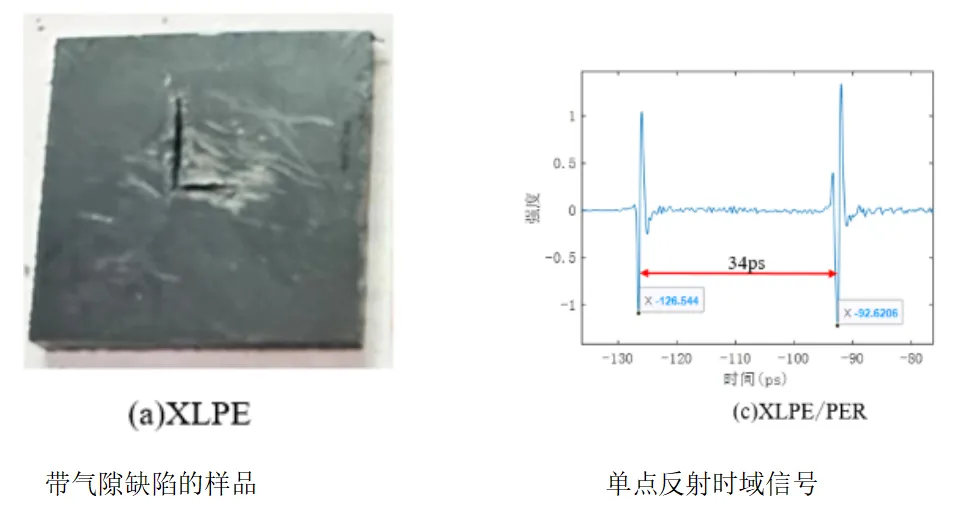
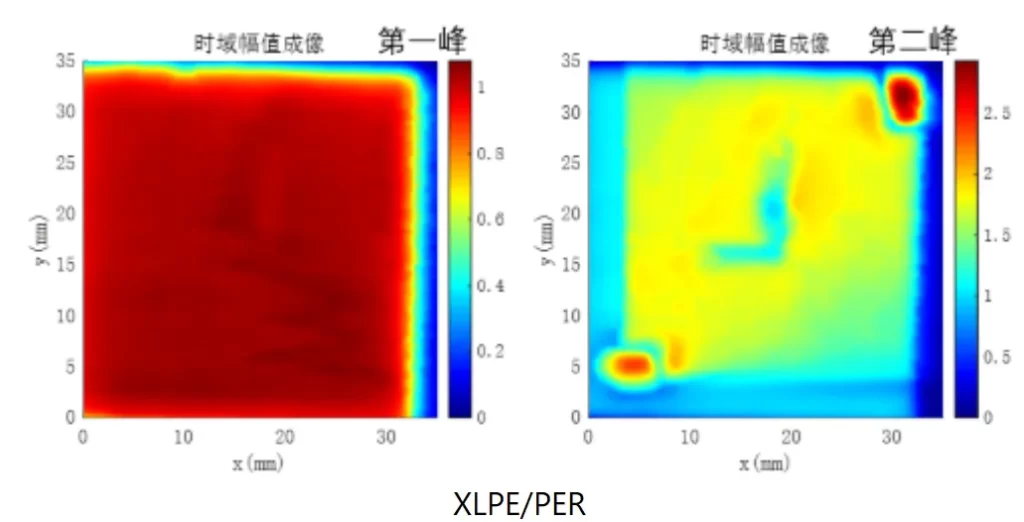
Time-domain imaging: the "L"-shaped air gap can be clearly seen in the time-domain amplitude at the XLPE/PER interface.
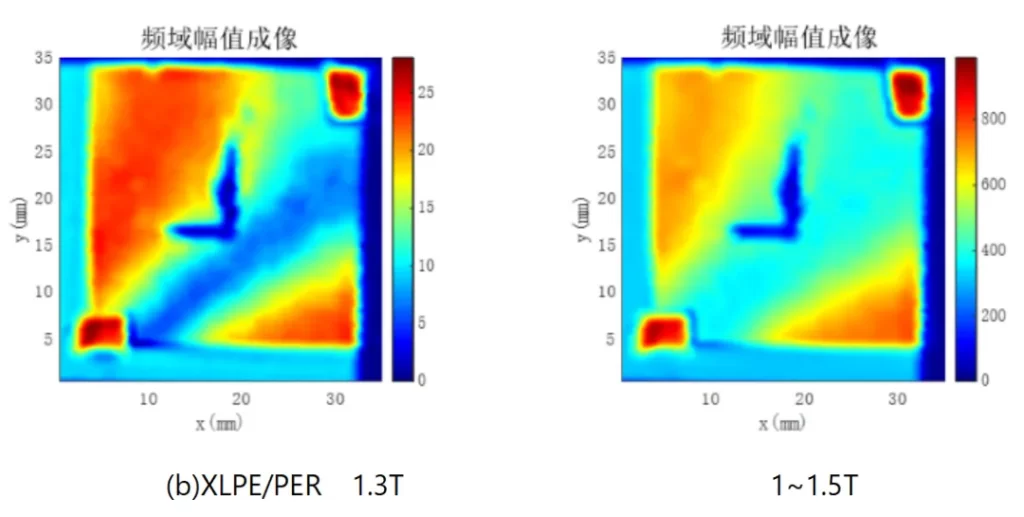
Frequency-domain imaging: in the frequency domain, XLPE images well over a wide range of 1–1.5 THz, with the air gap size almost identical to its actual size; the red patterns in the lower-left and upper-right corners are adhesive tape.
Summary: Taking XLPE (cross-linked polyethylene) material as an example, our company used a self-designed and built external reflection system to conduct experimental tests on prepared XLPE plate samples. Ideal test results were obtained in both time-domain and frequency-domain imaging, allowing relatively accurate detection of air-gap defects. This demonstrates that terahertz technology can perform non-destructive testing in insulator inspection with good results, breaking through the bottleneck of traditional destructive testing.
4. Technology implementation and future optimization directions
At present, the terahertz insulator inspection equipment has completed core technology verification, and the inspection results have been confirmed to be completely accurate through disassembly verification, demonstrating good practicality. However, to achieve large-scale promotion, continuous optimization is still needed in the following aspects:
1. Improving detection distance and resolution;
2. Reducing the influence of environmental interference;
3. Intelligent data analysis;
4. Cost optimization.
5. Conclusion
As the "safety guardians" of power systems, the health status of insulators is directly related to the stable operation of the power grid. With its core advantages of "non-destructive penetration, precision, and high efficiency", terahertz technology breaks through the technical bottlenecks of traditional insulator inspection, providing full-dimensional, damage-free inspection solutions for scenarios such as transmission lines and substations. As the technology continues to mature and optimize, terahertz insulator inspection equipment will become a "standard tool" for power operation and maintenance, helping the power grid achieve the goal of "precise operation and maintenance, safety and efficiency", and injecting technological momentum into energy security.
Technology changes life. From "huge" to "handheld", terahertz technology is opening a brand-new era of perception.
What application of terahertz technology interests you most? Feel free to leave a comment and discuss!
Follow us for more cutting-edge technology updates...
-END-
Text|Peng Bao
Layout|Xiang Shaolian