Contributed by: Xie Peiyao
Introduction: The "Potential" of Terahertz Radiation
If terahertz (THz) radiation were given a nickname, "the rising star of electromagnetic waves" might be the most fitting. Lying between microwaves and infrared light, it possesses unique penetrability and flexibility, making it a new favorite in materials science and information technology.
What is even more exciting is that THz is not just a "scout" — it can penetrate deep into matter and interact directly with the electrons inside. Today, we introduce how this interaction affects the anisotropic magnetoresistance (AMR) effect of magnetic materials, and how this phenomenon presents fresh research perspectives when driven by THz radiation.
The Anisotropic Magnetoresistance (AMR) Effect: Letting Electrons "Go Their Own Way"
The AMR effect refers to the phenomenon where, when an external magnetic field forms a certain angle with the internal magnetization of a magnet, the magnetization vector inside the magnet deflects, and the longitudinal resistivity of a magnetic material varies with the angle between the magnetization direction and the current direction — showing a dependence on the angle of the applied magnetic field. This is a very important electrical phenomenon, widely used in magnetic sensors and information storage devices. By adjusting the direction of the applied magnetic field, the resistance of the material can exhibit significant differences, helping us detect and control the behavior of electrons more precisely.
In simple terms, AMR is a way for magnetic materials to "find their way": it makes electrons "travel differently" in different directions. This effect is closely related to the material's crystal structure, magnetic anisotropy, electron scattering behavior and other factors.
Terahertz Radiation and the AMR Effect: A "Subtle Encounter"
1. Detection capability of high-frequency response: Terahertz AMR can explore the magnetic response of materials at high frequencies, providing information that DC AMR cannot — especially in the terahertz band, where the electronic and magnetic behavior of materials may differ from that under low-frequency conditions.
2. Potential application value:
Information storage and processing: The terahertz band enables rapid information transmission and processing. Studying the terahertz AMR of materials helps develop new types of terahertz magnetic memory and high-speed magnetic sensors.
Quantum computing and spintronics: Terahertz AMR can provide new avenues for exploring materials and mechanisms for quantum computing and spintronics. Electronic excitation in the terahertz band may interact with quantum states, opening up new research directions.
Literature Analysis
Traditionally, the origin of AMR has been attributed to extrinsic mechanisms — spin-dependent electron scattering caused by crystal defects (such as impurities and phonons). In recent years, theoretical studies have pointed out that AMR can also be significant even in perfect crystals, possibly due to an intrinsic mechanism (i.e., scattering-independent). Some studies have found signs of the intrinsic contribution of AMR through electrical transport measurements and first-principles theory, but have also shown that more direct and flexible experimental methods are needed to precisely extract the extrinsic and intrinsic components of AMR.
Extrinsic and intrinsic AMR:
Extrinsic AMR: Related to electron scattering rates (such as scattering between electrons and impurities or phonons); its influence gradually weakens as frequency increases, especially in the frequency range above 20 THz.
Intrinsic AMR: Independent of scattering effects, mainly caused by changes in the group velocity of electrons; frequency variation has little effect on it, so it shows a stronger intrinsic contribution in the high-frequency region.
The authors of the paper performed extensive AMR measurements on common ferromagnetic materials using broadband spectroscopy, exploring the contributions of extrinsic (scattering-dependent) and intrinsic (scattering-independent) AMR. The samples studied include common ferromagnetic materials such as Co, Ni, Ni₈₁Fe₁₉ and Ni₅₀Fe₅₀ thin films.
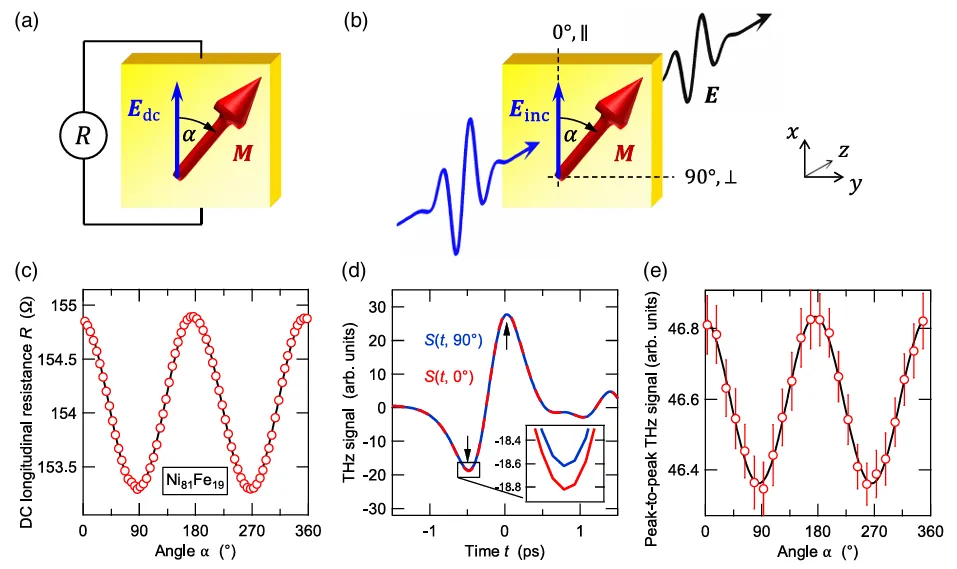
Figure 1 shows the measurement methods of conventional DC AMR and terahertz AMR. DC data are directly expressed in the material's resistance value, while terahertz spectroscopy measurements are mainly expressed in the amplitude of the material's transmitted signal. Under both measurement methods, the AMR parameter can be observed to vary periodically with a period of π as the angle between the applied magnetic field M and the current E direction changes.
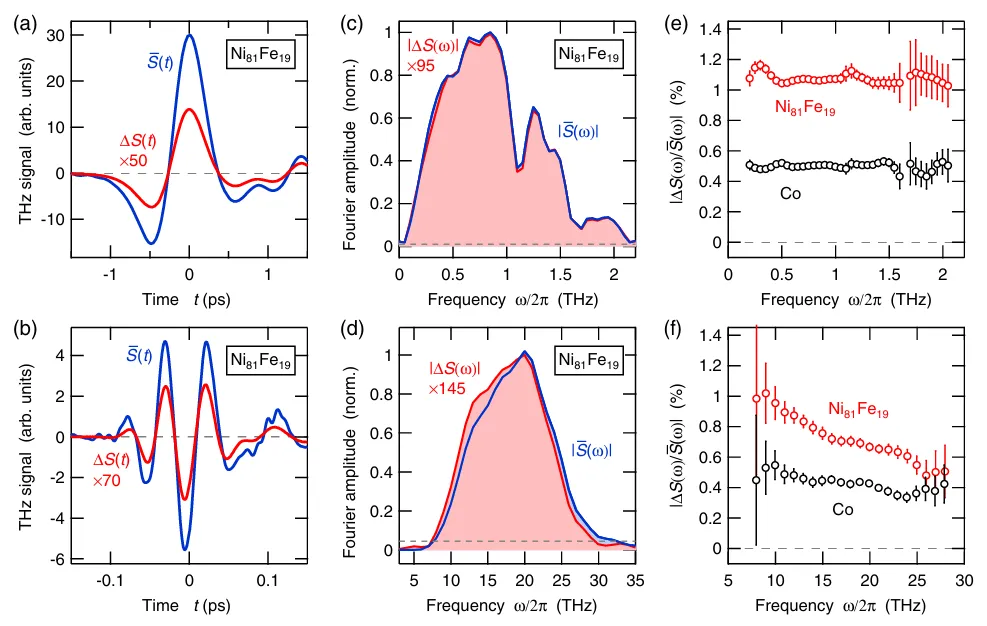
By analyzing the time-domain and frequency-domain THz responses of the materials, the contributions of extrinsic and intrinsic AMR can be distinguished (Figure 2). The magnetoresistance response of the materials has different characteristics at low frequencies (0.2–2 THz) and high frequencies (8–28 THz). The low-frequency region is mainly dominated by extrinsic contributions (electron scattering), while the high-frequency region leans more toward intrinsic contributions (effects related to electron group velocity).
By comparing the AMR responses of Ni₈₁Fe₁₉ and Co thin films, it was found that Ni₈₁Fe₁₉ exhibits a larger AMR contrast in the low-frequency region, especially in the 0–2 THz band. For materials such as Ni₈₁Fe₁₉, the AMR response weakens as frequency increases, particularly in the 10–20 THz band. In contrast, the AMR of Co is almost unaffected by frequency, showing strong intrinsic AMR, and this contribution remains significant even at 30 THz. This may be related to the hexagonal crystal structure of Co.
Conclusion: This study shows that broadband terahertz magnetoresistance measurements can effectively distinguish and quantify the contributions of extrinsic and intrinsic AMR. Meanwhile, the study of terahertz anisotropic magnetoresistance provides us with a powerful tool for deeply understanding the electronic transport properties of magnetic materials, especially their behavior at high frequencies. Future research can further explore the intrinsic AMR characteristics of different materials and promote the application development of terahertz spintronics.
Reference:Nádvorník L, Borchert M, Brandt L, et al. Broadband terahertz probes of anisotropic magnetoresistance disentangle extrinsic and intrinsic contributions[J]. Physical Review X, 2021, 11(2): 021030.