Author: Yin Tinggui
Introduction: Detecting electromagnetic radiation scattered from the tip–sample junction has made it possible to overcome the diffraction limit and has opened up the flourishing field of polariton nano-imaging. However, most techniques only resolve the amplitude and relative phase of the scattered radiation. Recently, a research team from the University of Regensburg in Germany and other institutions used spacetime imaging technology to precisely measure the group velocity and phase velocity of terahertz SPPs in graphene, revealing the deep connection between their propagation dynamics and material properties. This work was published in the journal Nano Letters under the title "Spacetime Imaging of Group and Phase Velocities of Terahertz Surface Plasmon Polaritons in Graphene".
1. Sample preparation
The research team employed two graphene preparation techniques: dry exfoliation to obtain monolayer graphene (MLG), and chemical vapor deposition (CVD) to grow large-area MLG. The key lies in substrate treatment — cleaning the SiO₂/Si substrate with oxygen plasma to reduce the influence of trapped charges in the dielectric layer. It is particularly noteworthy that a PMMA film was used to assist the CVD transfer process, combined with ammonium persulfate etching of the copper substrate, ultimately transferring the graphene onto a high-resistivity SiO₂/Si substrate. This process ensured sample uniformity and low defect density, laying the foundation for subsequent experiments.
2. Spacetime scanning: capturing the dynamic trajectories of SPPs
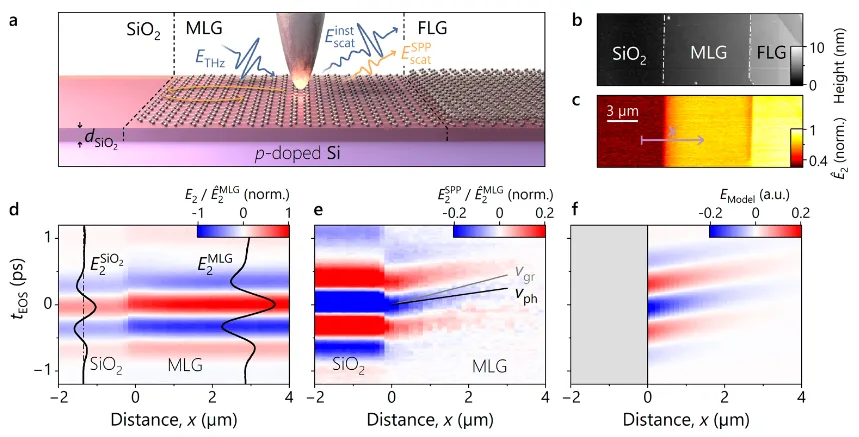
The experiment utilized the conventional polariton echo-localization detection technique, enhanced by directly resolving the scattered electric field through electro-optic sampling. The reflection and propagation of terahertz pulses at the graphene interface were recorded to construct a "spacetime map". It is worth mentioning that, to improve the signal-to-noise ratio, the study adopted a multi-reference waveform averaging method: scattered signals were extracted from regions far from the edge as references, and by subtracting the references, the propagation image of the SPPs was extracted from the time-domain signal, while also avoiding waveform distortion caused by interface proximity. The study found that when the probe crosses the MLG/FLG (few-layer graphene) interface, the SPPs exhibit tilted propagation trajectories, and the reflected wave amplitude is significantly lower than at the substrate/graphene interface. The team speculated that this phenomenon arises from differences in reflection conditions caused by different dielectric boundaries.

3. Quantifying time shifts: resolving nanoscale dynamics
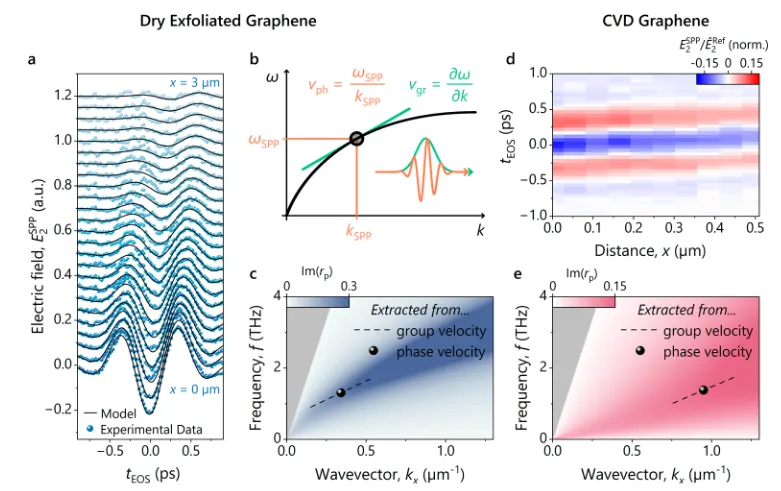
By fitting a Gaussian wave packet model (Eq. 1), the study precisely quantified the time shifts of the SPPs. The results show that the time difference Δt₀ between adjacent waveforms is about 10 fs, in close agreement with the theoretical group velocity value. The slight deviation stems from the residual influence of the substrate on the SPPs near the edge. This sub-femtosecond-level time resolution provides key data for revealing the group velocity and phase velocity of the SPPs, thereby helping to construct a two-dimensional propagation vector field.
4. Modeling and characterization: decoding the propagation mechanism
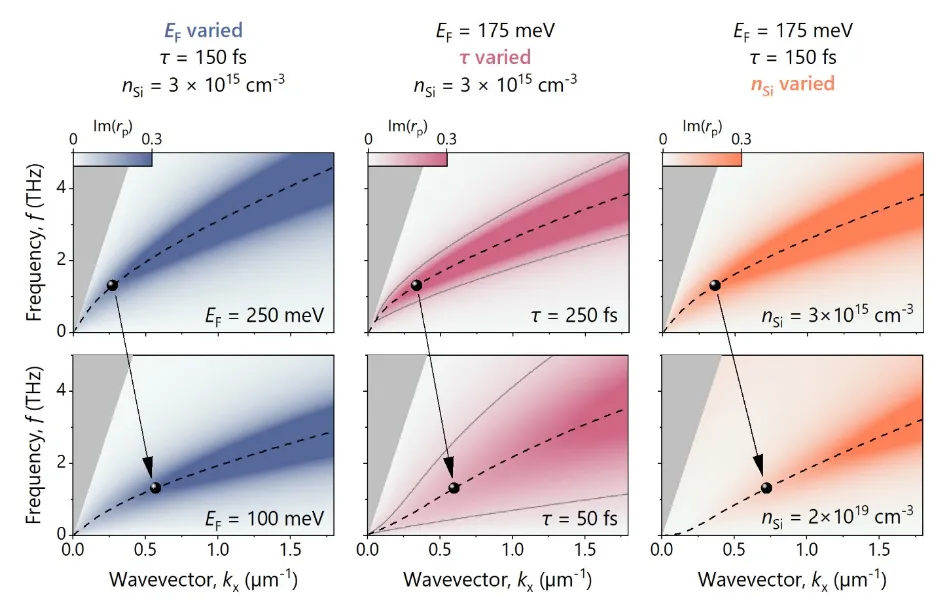
The team combined theoretical models with experimental data to systematically analyze the propagation characteristics of SPPs. The study found that Fermi energy, carrier scattering time, and substrate doping concentration all significantly affect the SPP dispersion relation: lowering the Fermi energy (from 250 meV to 100 meV) can increase the SPP confinement factor from 10 to 21; shortening the scattering time leads to broadening of the dispersion curve and blurring of characteristic peaks. In addition, the "acoustic surface polarization" effect induced by highly doped silicon substrates further enriches the dimensions of SPP tuning.
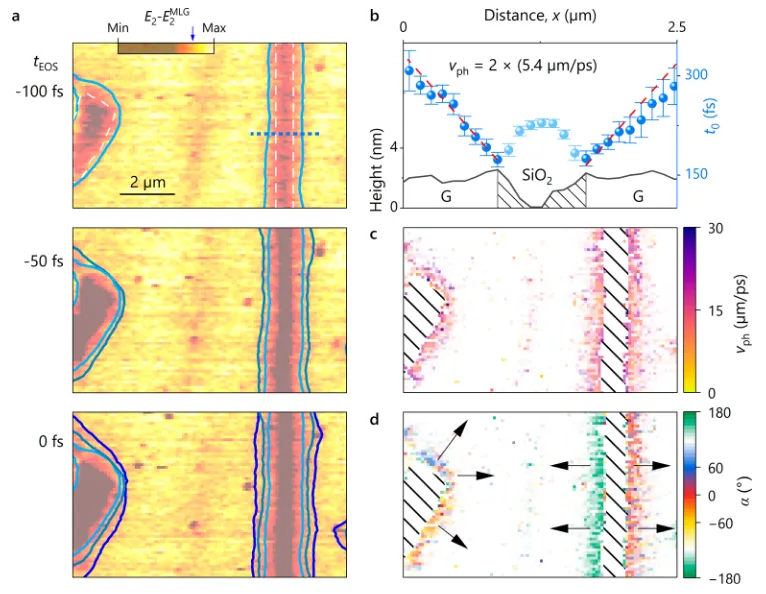
Moreover, the technique goes beyond one-dimensional polariton propagation and can visualize the spacetime evolution in a complete femtosecond snapshot movie, enabling visualized imaging of polaritons in materials with more complex edge geometries.
5. Precise control of non-equilibrium SPP dynamics by ultrafast pump laser
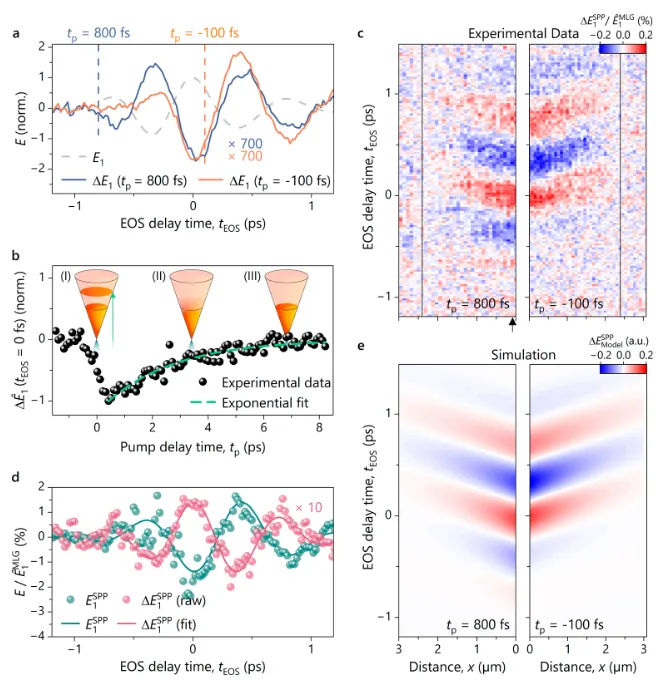
The introduction of a pump laser (pulse width 140 fs, central wavelength 515 nm, fluence 14.5 μJ/cm²) can change the conductivity of graphene. When in the excited state, the terahertz conductivity of graphene decreases, thereby altering the propagation characteristics of SPPs. Similar to the unpumped case, as the distance from the interface increases, the signal intensity decreases and the waveform shifts toward later tᴇᴏs.
In summary, this article demonstrates an innovative near-field imaging method that directly resolves polariton propagation in the time domain, using graphene SPPs as a benchmark system. Phase velocity, group velocity, and damping can be extracted directly from a single spacetime map without entering the frequency domain, which allows us to extract a considerable portion of the information in the polariton dispersion curve, even in the case of strongly damped polaritons at room temperature. Meanwhile, by recording femtosecond snapshots, the temporal evolution of polaritons can be tracked in two dimensions, and combined with pump-probe techniques, sub-wavelength control of non-equilibrium polaritons can be achieved. Furthermore, this technique can be easily extended beyond graphene to probe polaritons in a wide range of materials, including anisotropic polaritons in α-MoO3 and black phosphorus, surface modes in topological insulators, and alternative spectral ranges where electro-optic sampling of the scattered electric field is feasible.
Paper information: Anglhuber S, Zizlsperger M, Pogna E A A, et al. Spacetime Imaging of Group and Phase Velocities of Terahertz Surface Plasmon Polaritons in Graphene[J]. Nano Letters, 2025, 25(6): 2125-2132. DOI: 10.1021/acs.nanolett.4c04615.