Author: Yu Shuchao
It has been pointed out that the simplest way to judge whether a wave is completely confined or bound within a physical system is to check whether the frequency of the electromagnetic wave lies outside the continuum range spanned by propagating waves. If it does, the electromagnetic wave has no path or channel to radiate into free space and can only exist in the form of a bound state[1]. Conversely, if the frequency of a wave state lies within the continuum range and it is a resonant state that radiates from the system to infinity, this mode is called a leaky mode.
Bound States in the Continuum (BICs) are an exception: they coexist with other extended waves within the continuum, yet are completely bound without any radiation. BICs widely exist in various systems and are fundamentally different from traditional bound states.
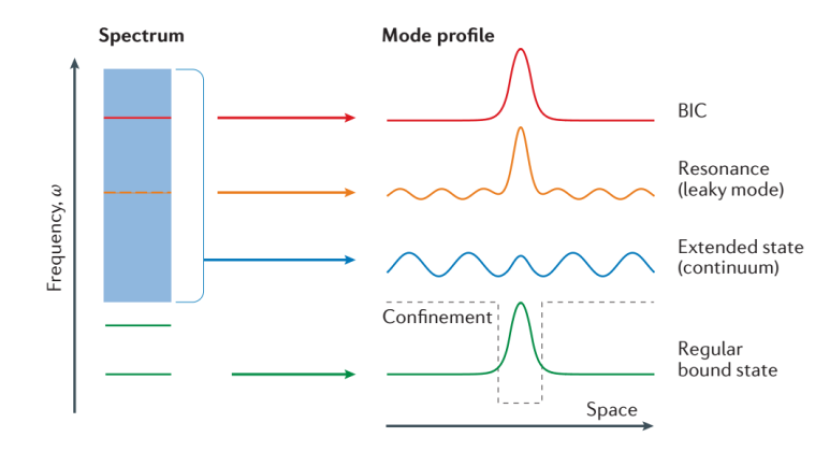
As shown in Fig. 1, outside the continuum of a certain physical system, there are discrete energy levels of traditional bound states (green line), which have no channel for outward radiation, like electrons in the outer orbitals of an atomic nucleus. Within the continuum range, resonant states similar to bound states occur (orange line); these modes involve coupling between the resonant state and extended waves (blue line). Such resonant states have a complex frequency ω = ω₀ − iγ, strictly defined as an eigenvalue of the wave equation with outgoing boundary conditions, where ω₀ is the resonant frequency and γ represents the leakage rate. For bound states in the continuum, γ equals 0, meaning these resonant states do not leak out and are completely bound within the continuum. Therefore, bound states in the continuum can be regarded as resonant states with extremely narrow resonance linewidths and infinite quality factors — resonant states without leakage, exhibiting decoupling of the resonant state from the radiation spectrum[2].
BICs can be divided into two major categories according to how they decouple from far-field radiation. One category is symmetry-protected BICs or separable BICs, and the other is accidental BICs, also known as parameter-tuned BICs.
Symmetry-protected BICs or separable BICs
The first major category can be divided into three subcategories: symmetry-protected BICs, separable BICs, and permittivity-protected BICs.
Symmetry-protected BICs
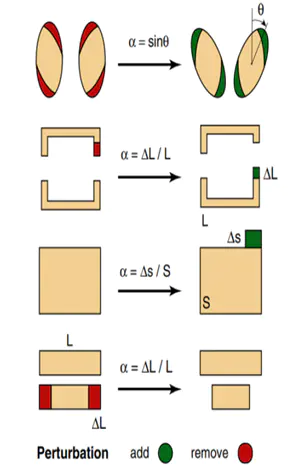
The wavefunctions of symmetry-protected BICs possess certain spatial symmetries, such as rotational symmetry, mirror symmetry, and axial symmetry. As long as the system's symmetry is maintained, the bound states and extended states remain orthogonal and decoupled. If a perturbation breaks the symmetry, the bound state may leak into the extended states, becoming a quasi-BIC, which can then be observed experimentally.
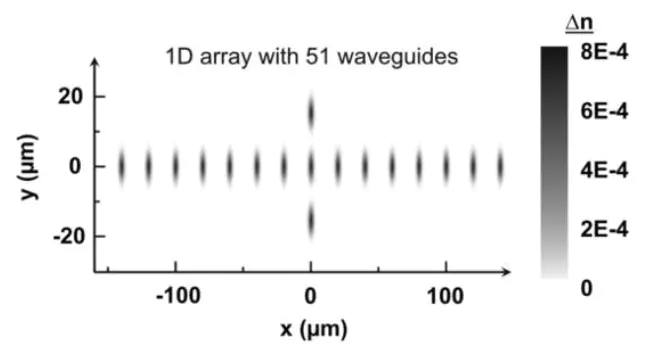
Taking the optical waveguide model as an example, Yonatan Plotnik proposed a symmetry-protected BIC model in 2011[3]. As shown in Fig. 3, two additional optical waveguides are placed above and below the central waveguide of a one-dimensional optical waveguide array. The BIC is realized through the antisymmetric mode in the vertical direction, while all array modes are symmetric. The BIC of this structure does not couple with any mode of the array, so it is an ideal BIC. By breaking the structural symmetry, the BIC can be converted into a leaky mode with a finite lifetime, thereby enabling efficient optical control.
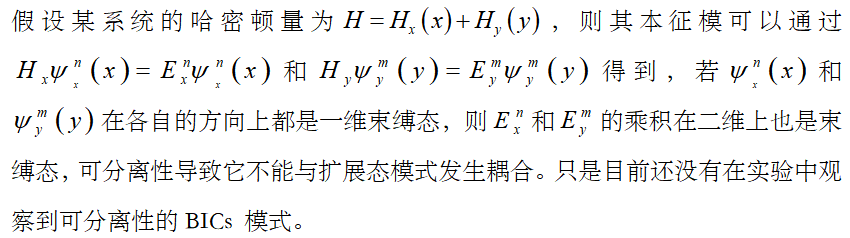
Separable BICs
Permittivity-protected BICs

Permittivity-protected BICs are realized by introducing asymmetry into an isotropic permittivity. This new approach allows optical resonances to be manipulated through small changes in the isotropic permittivity while maintaining geometric symmetry[4].
Accidental BICs (parameter-tuned BICs)
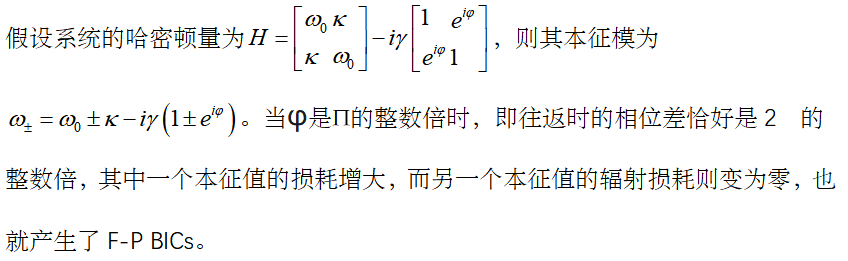
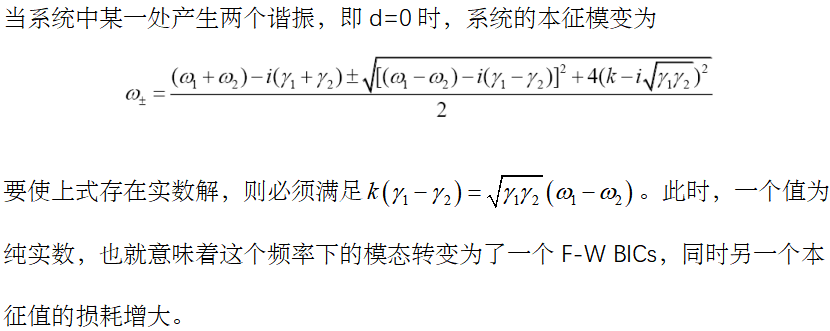
The second category can also be divided into three subcategories: Fabry-Perot BICs, Friedrich-Wintgen BICs, and single-resonance-parameter BICs. These BICs achieve decoupling from the far field through destructive interference between radiation channels by adjusting system parameters.
Fabry-Perot BICs

Friedrich-Wintgen BICs
Single-resonance-parameter BICs
The previous two methods of exciting BIC modes require two or more coupled resonances. When parameters are tuned appropriately, a single resonance can also excite a BIC mode, which is called a single-resonance-parameter BIC mode.

When a photonic crystal slab possesses C2 symmetry, up-down mirror symmetry, and time-reversal symmetry, the number of radiation channels is reduced, and at general k points along the Γ to X direction, the resonance transforms into a bound state.
From another perspective, both major categories of BICs achieve decoupling from far-field radiation through specific means, but the methods and mechanisms differ greatly. Symmetry-protected BICs rely on the symmetry of the system, while accidental BICs rely on fine-tuning of system parameters. These two methods each have their advantages and limitations, and the appropriate method needs to be selected according to the specific application scenario and requirements.
Therefore, understanding the working principles and characteristics of these two types of BICs is crucial for us to design and implement efficient photonic devices and systems.
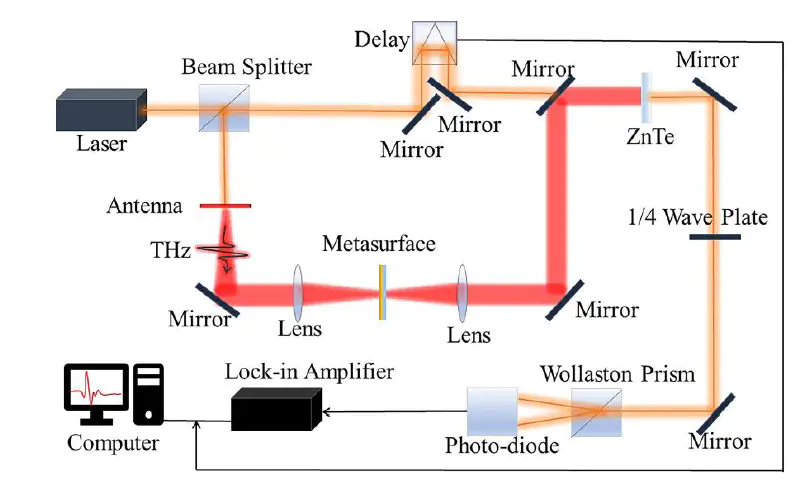
Terahertz time-domain spectroscopy (THz-TDS) is commonly used to measure the transmission and reflection spectra of metasurfaces. In experiments, the time-domain signal is usually obtained directly and needs to be Fourier-transformed to obtain the desired spectrum. In actual measurements, since the terahertz source signal is relatively weak and susceptible to external interference, the signal measured from an unprocessed blank substrate is usually used as a reference to reduce interference from the substrate and the detection environment. When processing the data, the transmission spectrum of the metasurface is divided by the transmission spectrum of the reference signal to obtain the transmission curve of the metasurface; when processing phase information, the phase spectrum of the reference substrate is subtracted from the phase spectrum of the metasurface. The system must perform measurements in a dry environment, generally using an air dryer or continuously introducing nitrogen to reduce the absorption of terahertz waves by moisture in the air. During testing, due to the presence of secondary reflection peaks, the maximum scan duration generally cannot be reached, so the signal needs to be truncated, but this can still meet the testing requirements of most metasurface spectra[8].
References:
[1] Von Neumann J, Wigner E P. Über das Verhalten von Eigenwerten bei adiabatischen Prozessen[M]//Wightman A S. The Collected Works of Eugene Paul Wigner. Berlin, Heidelberg: Springer Berlin Heidelberg, 1993: 294-297.
[2] Yang Qiusheng. Research on all-dielectric nonlinear metasurfaces based on bound states in the continuum[D]. Harbin Engineering University, 2021. DOI:10.27060/d.cnki.ghbcu.2021.000416.
[3] Plotnik Y, Peleg O, Dreisow F, et al. Experimental Observation of Optical Bound States in the Continuum[J]. Physical Review Letters, 2011, 107(18): 183901.
[4] Yu S, Wang Y, Gao Z, et al. Dual-band polarization-insensitive toroidal dipole quasi-bound states in the continuum in a permittivity-asymmetric all-dielectric meta-surface[J]. Optics Express, 2022, 30(3): 4084-4095.
[5] Zhang Xingyuan. Research on bound states in the continuum of terahertz metasurface structures based on metallic materials[D]. Tianjin University, 2022. DOI:10.27356/d.cnki.gtjdu.2022.001358.
[6] Hsu C W, Zhen B, Lee J, et al. Observation of trapped light within the radiation continuum[J]. Nature, 2013, 499(7457): 188-191.
[7] Zeng Dehui. Research on terahertz amplitude modulation and phase modulation devices[D]. Guilin University of Electronic Technology, 2022. DOI:10.27049/d.cnki.ggldc.2022.000312.
[8] Chen Yun. Research on bound-state-in-the-continuum metasurface devices and coupling applications based on coupled-mode theory[D]. Guilin University of Electronic Technology, 2024. DOI:10.27049/d.cnki.ggldc.2024.000003.