Background
In magnetically ordered systems, the collective excitation of spin precession is the spin wave, whose quantum is the magnon.
Nonlinear coupling between magnetic excitations can fundamentally provide new ways to manipulate spin waves beyond what linear superposition can achieve, and holds promise for developing all-magnon signal processing devices. If two magnon modes are driven from equilibrium into an anharmonically coupled state, different magnon modes may undergo nonlinear mixing, giving rise to Manley–Rowe dynamics of magnon coherence, analogous to the difference-frequency and sum-frequency generation (DFG and SFG) observed in nonlinear optics. Therefore, these coherently coupled signals (DFG and SFG) provide exclusive evidence of magnon-magnon interactions.
However, coherent magnon-magnon mode mixing is usually hidden in conventional spectra dominated by linear magnon excitations, and the existence of these coherent couplings, as well as their exact excitation pathways, has not been established until now.
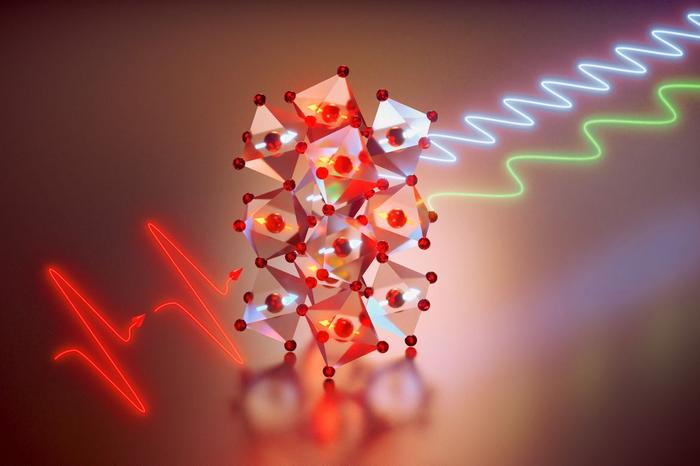
Based on this, Zhuquan Zhang, Keith A. Nelson, and colleagues from the Department of Chemistry at MIT published an article in Nature Physics titled "Terahertz field-induced nonlinear coupling of two magnon modes in an antiferromagnet". The researchers used two-dimensional coherent terahertz polarization spectroscopy to measure the coherence and interactions between two distinct magnon modes in the canted antiferromagnet YFeO3 at room temperature. By converting the time-domain response into two-dimensional (2D) frequency-frequency maps, they revealed the nonlinear mixing of anharmonically coupled magnon modes. The unique coherence observed in this study may lead to future advances in quantum technologies based on nonlinear magnon mixing, such as all-magnon mixers and converters.
Research overview
Magnon modes in YFeO3
First, the researchers studied the response of the magnon modes in YFeO3 to a single linearly polarized terahertz pulse. The sample exhibits pronounced anisotropy to the terahertz magnetic field, and two magnon modes were observed: qFM (0.30 THz, HThz||a) and qAFM (0.53 THz, HThz||c). When the terahertz magnetic field is polarized along a crystal axis, only one magnon mode can be excited; when the terahertz magnetic field is off-axis, the field interaction contains components that simultaneously induce the excitation of both modes.
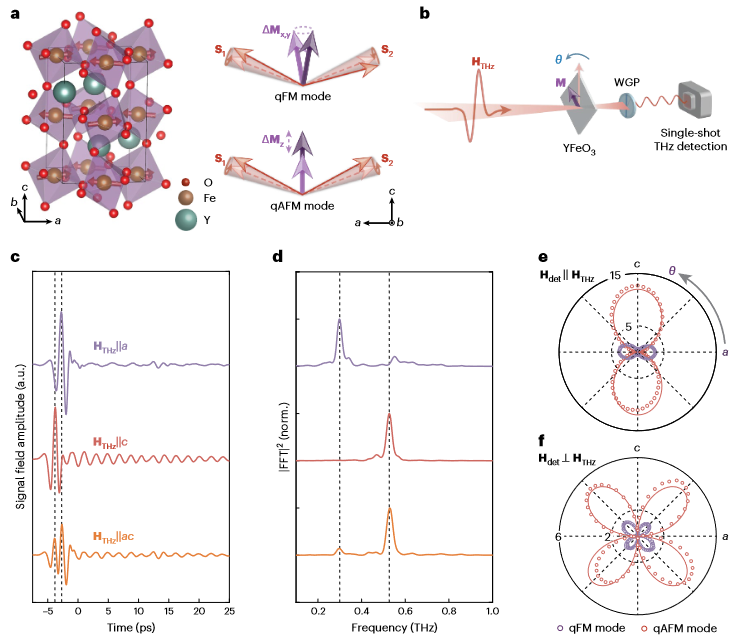
Fig. 1 Distinct magnon modes exist in the canted antiferromagnet YFeO3.
Nonlinear coupling between the two magnon modes in YFeO3
The researchers used coherent two-dimensional terahertz polarization spectroscopy to extract the weak nonlinear response from the free induction decay (FID) signal, and classified and compared the measurement results for three different incident THz magnetic field directions. When the terahertz magnetic field is along a crystal axis, a third-order nonlinear optical response generated by degenerate four-wave mixing can be observed, as shown in Fig. 2d and 2e. Measurements with the terahertz magnetic field along the bisector of the two axes revealed four additional peaks: a pair of difference-frequency signals (0.23 THz) and a pair of sum-frequency signals (0.83 THz) from the two magnon modes.
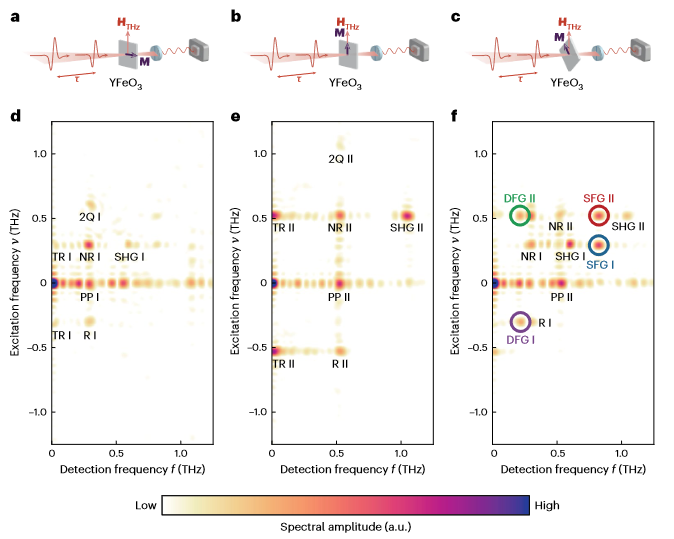
Fig. 2 Nonlinear two-dimensional terahertz spectra of YFeO3.
Second-order nonlinear field dependence and 2D terahertz polarization characteristics of YFeO3
The researchers used 2D spectroscopy to characterize the terahertz magnetic field dependence and field polarity dependence of the SFG and DFG signals. In all cases, the amplitudes of these signals are proportional to the square of the incident terahertz magnetic field, as shown in Fig. 3a and 3d, consistent with their assignment to magnetic processes. Moreover, both second-order signals depend on two distinct magnon modes driven along orthogonal coordinates, and emission only along the a-axis produces the polarization patterns of the SFG and DFG signals, as shown in Fig. 3b, c, e, and f.

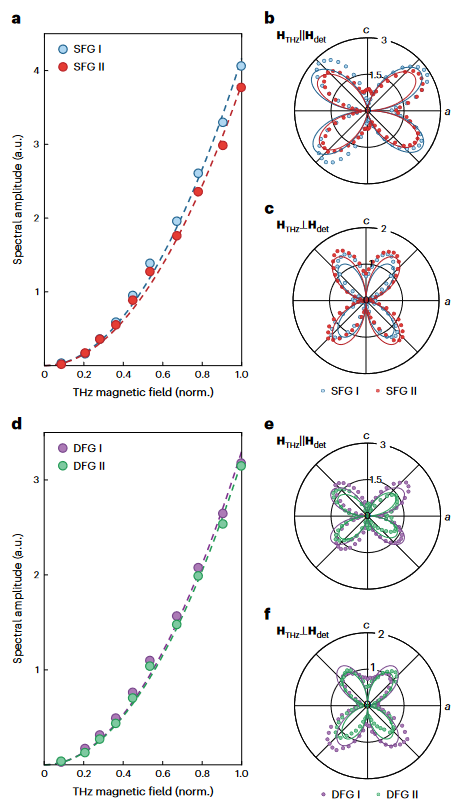
Fig. 3 Field dependence and two-dimensional terahertz polarization characteristics of the SFG and DFG signals.
The azimuthal dependence of the signals is:

Formation mechanism of the second-order nonlinearity in YFeO3
When the qFM and qAFM modes are driven out of equilibrium, coherent magnon-magnon mixing signals with a distinctive anisotropic response appear, as shown in Fig. 4a. Fig. 4b depicts the energy level diagram of the nonlinear magnon states in the presence of these coherent couplings. The linear interaction between the THz magnetic field and the spins leads to single-magnon one-quantum (1Q) coherence between the ground state and an excited magnon state, radiating a signal at frequency ΩqFM or ΩqAFM depending on which mode is driven. Assisted by a second field interaction, the 1Q coherence between the ground state and the excited qFM (qAFM) mode can be promoted to an SFG coherence involving the other magnon excitation, i.e., the qAFM (qFM) mode. In this case, direct coupling between the two magnon modes leads to the formation of a distinct correlated magnon state that accumulates phase at their sum frequency ΩqFM + ΩqAFM. Therefore, the appearance of the SFG signal heralds a coherent dynamical renormalization of the magnons beyond what thermal equilibrium can achieve. Alternatively, the two magnon modes can be driven sequentially from the ground state without forming a new state; having done so, they interact, resulting in DFG coherence between the two magnon states, accumulating phase at the difference frequency ΩqAFM − ΩqFM. The researchers simulated the magnetic dynamics using numerical solutions of the Landau-Lifshitz-Gilbert (LLG) equation. In all cases, the c-axis components of the spin trajectories cancel each other out, resulting in magnetization dynamics occurring purely along the a-axis, which is consistent with the experimentally observed anisotropic SFG and DFG emission patterns.
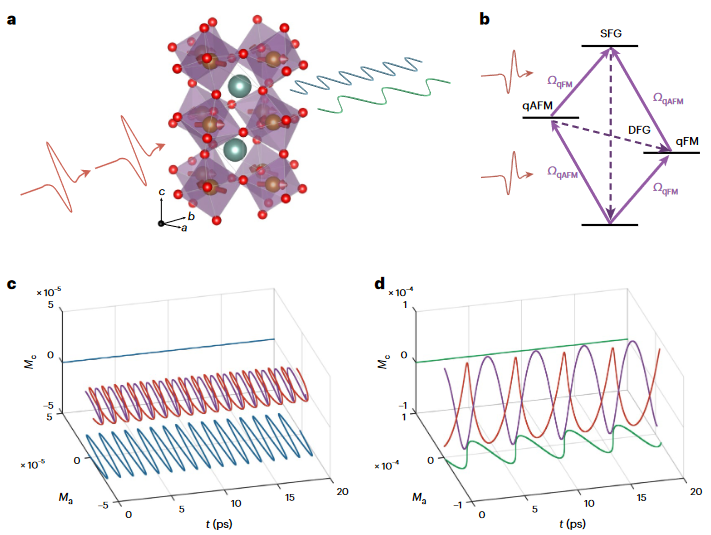
Fig. 4 Excitation pathways of the nonlinear magnon states.
Conclusion
This study highlights the advantages of two-dimensional terahertz spectroscopy in revealing coherent anharmonic coupling between distinct magnon modes, providing new research methods and technical means for investigating other exotic dynamics of magnetic excitations, such as magnon-phonon hybridization and multiferroic soft modes. Meanwhile, the unique coherence demonstrated in this work may lead to future advances in quantum technologies based on nonlinear magnon mixing, such as all-magnon mixers and converters.
Paper information
Z. Zhang et al., “Terahertz field-induced nonlinear coupling of two magnon modes in an antiferromagnet,” Nat. Phys., Jan. 2024, doi: 10/gtv28s.