Author: Tang Fu
EV Battery Manufacturing, Dry Electrodes, and Terahertz Time-Domain Inspection

As power batteries enter the TWh-scale manufacturing era, competition is extending from material systems to the manufacturing process itself. The thickness, density, loading, and porosity of electrode sheets determine cell capacity, consistency, safety margins, and manufacturing yield. Tesla's recently published patent on terahertz inline inspection for dry electrodes points to an important trend: battery production lines no longer perform quality checks only at the end — instead, picosecond-level time-of-flight signals directly participate in process control at the very moment the material is formed.
Fig. 1 Schematic of wet/dry electrode manufacturing processes, cell structure, and inspection targets
1. A huge application scenario: power battery manufacturing enters the "process control" era
The continued rise in EV penetration has made power batteries one of the most important growth tracks in global manufacturing. The IEA's Global EV Outlook 2026 shows that global EV sales exceeded 20 million units in 2025, accounting for about a quarter of global new car sales; EV battery deployment in the same year was about 1.2 TWh, and is expected to approach 3 TWh by 2030. At this scale, even a 1-percentage-point improvement in electrode sheet yield could correspond to enormous value in materials, energy consumption, and production capacity.
In lithium-ion batteries, electrode sheets consist of a metal current collector and an active material coating: the cathode is typically aluminum foil with an LFP, NMC, or similar cathode coating, and the anode is typically copper foil with a graphite or silicon-carbon coating. The separator, sandwiched between the cathode and anode, is a porous insulating membrane responsible for preventing electronic short circuits while allowing lithium ions to pass through. Electrode coatings, electrode sheets, and separators are three different objects: Tesla's patent focuses on inline metrology in dry electrode film/sheet manufacturing, not on inspecting the separator itself.
For vehicle manufacturers, batteries are not just purchased components — they are the core of cost, performance, and supply chain security. The strategic significance of Tesla's 4680 cells and the dry electrode route lies precisely in compressing materials, equipment, metrology, and process closed-loop control into the same manufacturing chain, trading manufacturing capability for cost and scale advantages.
2. Dry manufacturing: eliminating solvents and ovens, but you must see the "moment of film formation" clearly
The current mainstream electrode manufacturing is still the wet process: active materials, conductive agents, binders, and solvents are mixed into a slurry, coated onto Al/Cu current collectors, then passed through long ovens to remove the solvent, followed by calendering and slitting to form electrode sheets. The wet process is mature, highly adaptable to materials, and produces uniform coatings, but it requires large amounts of solvent and drying equipment, consumes high energy, occupies long factory floors, and the commonly used NMP solvent for cathodes brings recycling and environmental treatment costs.
Dry electrode manufacturing attempts to change the process at the source: active materials, conductive agents, and a small amount of binder are mixed in dry powder form, then undergo shearing, fibrillation, and multi-roll calendering to form a self-supporting electrode film, which is then laminated with a metal current collector. Its potential advantages are solvent-free processing, minimal drying, short process flow, small footprint, low energy consumption, and better suitability for thick electrodes and high-loading designs.
But the dry process also relies more heavily on process control. Powder dispersion, binder fibrillation, film strength, compaction density, porosity, and lamination quality with the current collector are all rapidly established in the calendering step. Wet-process lines typically inspect after coating and drying; dry-process lines need to know whether thickness and density deviate from target at the very moment the powder is pressed into a film. This is exactly where terahertz inline inspection comes in.
3. Terahertz inspection: from a quality dashboard to a production-line closed loop
Terahertz waves lie between microwaves and infrared, featuring non-contact, non-ionizing operation, the ability to penetrate many non-metallic materials, and sensitivity to porous structures and interfacial changes. For electrode coatings, terahertz pulses can produce reflections at the coating surface and at the metal current collector interface; the time difference between the two reflection peaks correlates with thickness, while reflection intensity and complex refractive index variations can be linked to density, loading, conductivity, and porosity.
TeraView's TeraCota battery inspection solution in the UK has already applied terahertz to non-contact inline inspection of anode/cathode coatings, targeting dry or wet electrodes and emphasizing the simultaneous evaluation of thickness, density, loading, and conductivity. Fraunhofer ITWM has also demonstrated inline terahertz thickness measurement of coatings on battery foils. Together they prove an industrial direction: terahertz is not just a research spectroscopy tool — it can also become a high-speed process metrology sensor in battery manufacturing.
The reason terahertz is being industrialized first for electrode sheet inspection is also clear: beneath the electrode coating there is an Al/Cu metal current collector that provides a strong reflective interface; the separator, by contrast, is typically a thin PP/PE porous membrane with low absorption, low reflection, and no metal backing, making stable inline detection more difficult.
4. The Tesla patent: connecting terahertz signals to calender roll control
According to the patent analysis materials provided by the user, Tesla published patent application US 2026/0126381 A1, titled "Inline Terahertz Measurement Device for Dry Electrode Film Manufacturing, and Methods Thereof". The key of this patent is not just "measuring thickness with terahertz", but feeding the measurement results directly back to the dry calendering process.
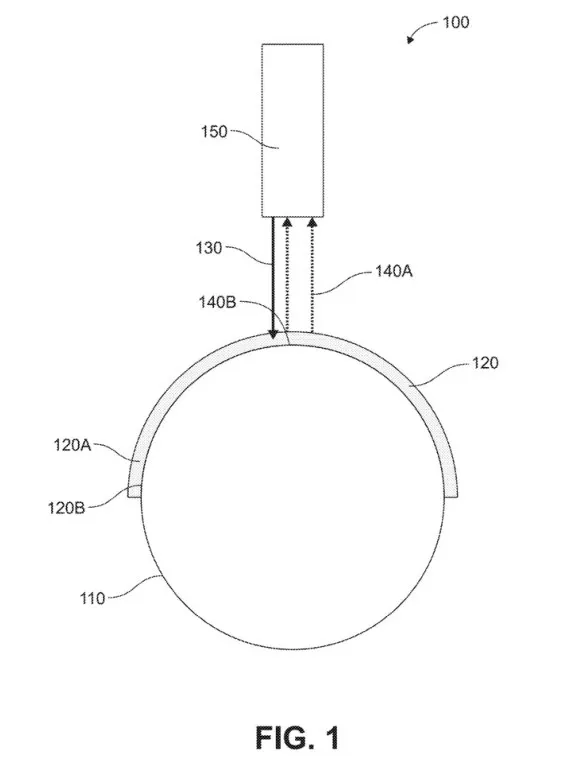
Fig. 2 Patent Fig. 1: terahertz pulses illuminate the electrode film on the roll surface, receiving reflection signals from the upper and lower surfaces
In the illustrated structure, the terahertz source and sensor are integrated into the same measurement head, mounted near the calender rolls. Terahertz pulses are normally incident on the dry electrode film being formed, and the sensor receives two reflection signals from the upper and lower surfaces of the film. Typical parameters listed in the patent materials include a frequency range of 0.05–5 THz, a spot diameter of 0.05–0.5 mm, and a pulse peak width of 1–5 ps. The time difference is used to calculate film thickness, and reflection intensity can be used to infer basis weight, density, and uniformity.
More importantly, the patent uses these measurement results to adjust three types of calendering parameters: roller shear ratio, line load, and gap offset. In other words, the terahertz signal is not just a number for engineers to look at — it is the basis for the calendering system to adjust parameters in real time.
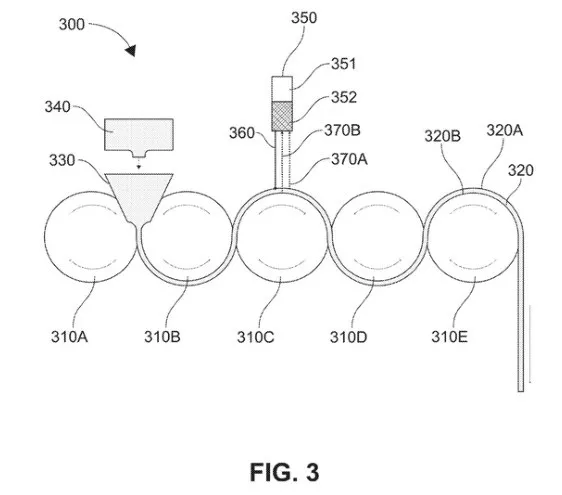
Fig. 3 Patent Fig. 3: dry powder enters the multi-roll system, is pressed into a film, and receives terahertz readings during rolling
The patent also shows a multi-roll dry film-forming process: dry powder enters the front roll gap from a feeding device and is pressed into a self-supporting film; it then undergoes further rolling and lamination with the current collector. Terahertz measurement heads can be arranged above key roll sections to read the state of the film at different forming stages.
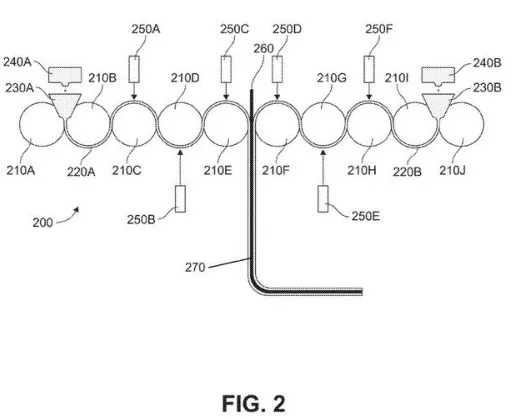
Fig. 4 Patent Fig. 2: a bilaterally symmetric dry-process line with multiple terahertz measurement devices, forming an inline metrology grid
The symmetric system shown in Fig. 2 goes further: dry powder is pressed into electrode films on both sides, which are then laminated with a metal current collector in the center to form a double-sided electrode. Multiple terahertz measurement devices are distributed at different roll positions and can be configured to measure loading, uniformity, or other physical properties. Traditional X-ray or beta-ray basis weight gauges mostly serve a quality inspection role, whereas Tesla's patent points to a more proactive closed loop: the sensor reads the material state, and the controller immediately corrects the film-forming conditions.
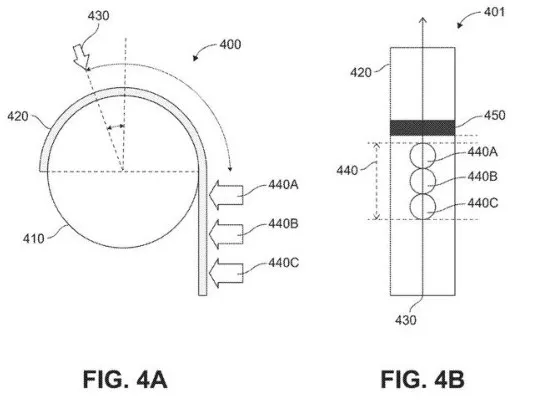
Fig. 5 Patent Fig. 4A/4B: calibrating inline terahertz signals through marking, sampling, and offline measurement
Inline inspection in mass production must solve the calibration problem. The patent proposes placing marks on the moving dry electrode film: the terahertz device first reads the inline data of that region, then a sample is cut from the same region for offline measurement, and the two sets of results are compared for calibration. This design anchors the high-speed waveform signals to traceable physical samples, preventing sensor drift from leading the closed-loop control astray.
Conclusion: advanced battery factories will increasingly resemble "real-time sensing systems"
From an industrial perspective, the value of Tesla's patent lies not in inventing terahertz thickness measurement itself, but in embedding terahertz inline metrology into dry electrode film formation and calendering control. It reflects the next stage of competition in battery manufacturing: whoever can obtain accurate data at the moment the material is formed is more likely to improve yield, reduce scrap, shorten line-adjustment cycles, and push new processes to scale.
Therefore, the real prospect of terahertz in the battery field is not just replacing X-rays or adding another inspection station, but becoming a "process control signal" in dry-process, thick-electrode, high-speed electrode sheet manufacturing. As TWh-scale capacity becomes the industry norm, picosecond-level detection technology is expected to move from a laboratory spectroscopy tool to a core sensor on power battery production lines.
···
Sources and image credits
IEA: Global EV Outlook 2026, data on EV sales and battery deployment. https://www.iea.org/reports/global-ev-outlook-2026
Tesla: 2025 Q4 Quarterly Update Deck, disclosures related to 4680 dry electrodes. https://assets-ir.tesla.com/tesla-contents/IR/TSLA-Q4-2025-Update.pdf
Patent: US 2026/0126381 A1, Inline terahertz measurement device for dry electrode film manufacturing, and methods thereof.
TeraView: TeraCota battery electrode metrology, public materials. https://teraview.com/battery/
Fraunhofer ITWM: Inline Thickness Measurement of Coatings on Battery Foils. https://www.itwm.fraunhofer.de/en/departments/processes-materials/layer-thickness-measurement/thickness-measurement-battery-foils.html
Image credits: Fig. 2–Fig. 5 are from the Tesla patent