In the field of nanophotonics, controlling the propagation of light at subwavelength scales has long been a research hotspot. Hyperbolic polaritons, as an optical mode capable of breaking through the diffraction limit, have attracted considerable attention in recent years. Traditional hyperbolic materials are often limited by the high losses of their metallic components, while naturally low-loss hyperbolic phonon polaritons are mainly confined to the mid-infrared band. However, two recent breakthrough studies have revealed that a natural van der Waals crystal called MoOCl2 supports low-loss hyperbolic plasmon polaritons (HPPs) at visible and near-infrared frequencies, opening up new avenues for high-frequency nanophotonics applications.
What are hyperbolic plasmon polaritons?
Hyperbolic polaritons are quasiparticles formed by the coupling of light with quantum excitations in materials (such as phonons or plasmons). Unlike the circular wavefronts propagating in isotropic materials, hyperbolic materials — whose dielectric tensor components have opposite signs — support polaritons with hyperbolic wavefronts. Their isofrequency contours (IFCs) are unbounded, allowing arbitrarily large wavevectors and thereby achieving extreme light confinement.

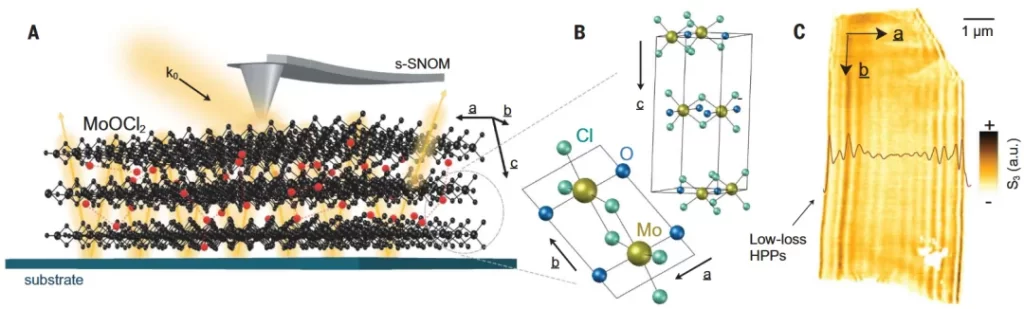
As a typical "bad metal", MoOCl2 has a resistivity as high as the Mott-Ioffe-Regel limit, with significant electron-electron interactions. Unexpectedly, however, Ruta et al. directly observed low-loss hyperbolic plasmon polaritons in MoOCl2 through nano-optical imaging [2], with propagation distances of up to several micrometers and lifetimes of hundreds of femtoseconds — even outperforming many "good metals".
Material properties and hyperbolic behavior of MoOCl2
MoOCl2 belongs to the oxychloride family and has a monoclinic crystal structure (space group C2/m), with layers coupled by van der Waals forces. Its crystal structure is highly anisotropic: Mo-O chains extend along the [100] direction, causing the plasma frequency (ωₚ) to differ significantly in orthogonal directions. Theoretical calculations by Venturi et al. show [1] that MoOCl2 possesses a broad hyperbolic window in the visible and near-infrared bands (εₓ < 0, εᵧ > 0, εz > 0), originating from its quasi-one-dimensional metallic character.
Ruta et al. further revealed the electronic structure of MoOCl2 through angle-resolved photoemission spectroscopy (ARPES) and quasiparticle self-consistent GW theory: orbital-selective Peierls distortion causes the dₓᵧ band to split, while the dₓᵧ/ᵧz bands exhibit partial incoherence near the Fermi surface. This many-body effect not only enhances the bonding-antibonding splitting, but also renormalizes the plasmon dispersion, deviating from predictions based on non-interacting theory.
Experimental observation: real-space nano-imaging and low-loss propagation
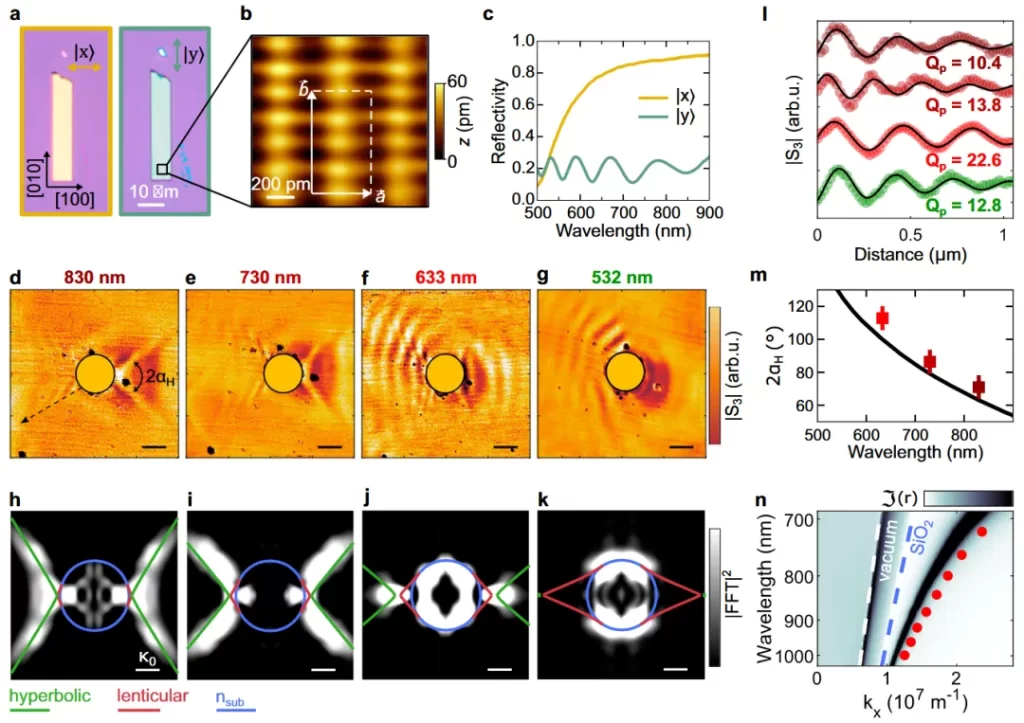
Both papers used scattering-type scanning near-field optical microscopy (s-SNOM) to perform real-space nano-imaging of MoOCl2 flakes. In Reference 1, the researchers fabricated gold disks on MoOCl2 as launchers, and observed the propagating wavefronts of hyperbolic HPPs via s-SNOM under laser illumination from λ₀ = 830 nm to 532 nm.
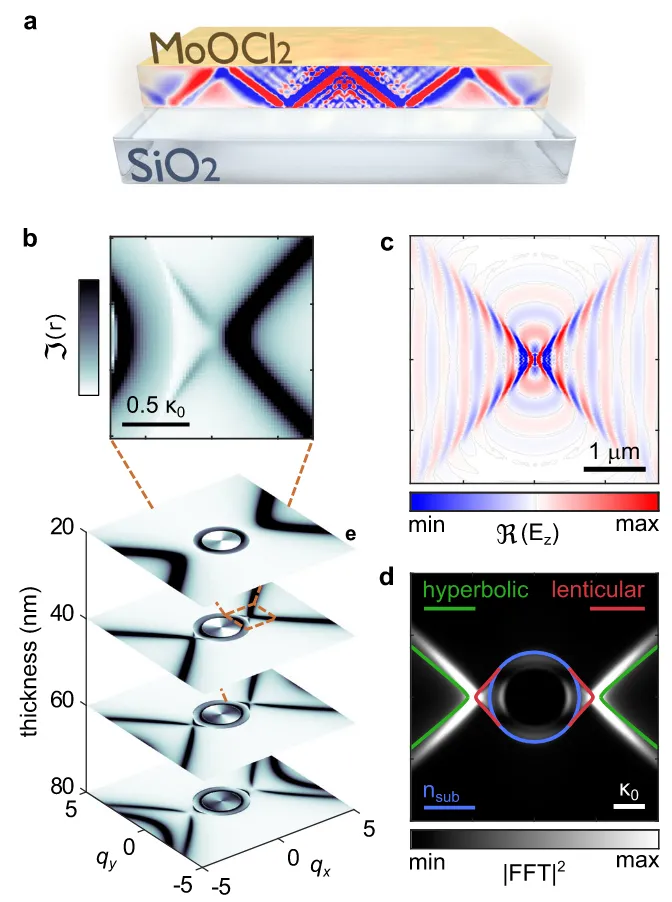
Reference 2 demonstrates that the quality factor Q of HPPs can reach 10, with about 10 propagation periods, and they remain stable at room temperature. Figure 4 of Reference 1 further confirms, through FFT analysis, the coexistence of hyperbolic modes and lenticular modes, whose propagation lengths are consistent with theoretical predictions.
Theoretical breakthrough: many-body effects and frequency-dependent scattering
Through Kramers-Kronig analysis, Reference 2 found that the plasma frequency of MoOCl2 (ωₚᵃ ≈ 5 eV) is lower than the prediction of non-interacting theory (≈ 6.4 eV), indicating that electron correlation effects lead to carrier renormalization. In addition, the contradiction between transport measurements and the high-frequency dielectric function suggests the existence of frequency-dependent scattering, possibly originating from low-frequency scattering by fluctuating charge density waves (CDW), to which high-frequency HPPs are immune.
Reference 1, meanwhile, verified the dispersion of HPPs through analytical models and full-wave simulations, and reported for the first time the existence of ghost modes in MoOCl2 — directional modes that possess complex wavevectors even in the absence of loss.
Application prospects: from super-resolution imaging to tunable photonic devices
The ability of MoOCl2's hyperbolic HPPs to operate in the visible band makes it an ideal platform for technological applications:
· Superlenses and super-resolution imaging: exploiting the unbounded wavevectors of hyperbolic modes, the diffraction limit can be broken for nanoscale lithography or biological imaging.
· Tunable optical elements: by tuning the electron density through electrostatic gating, MoOCl2 can be used to design compact polarization controllers or metasurfaces.
· Low-loss nanophotonic circuits: its air stability and low-loss characteristics provide new material for all-van-der-Waals nanophotonics.
The research in these two papers not only solves the loss problem of hyperbolic materials at high frequencies, but also provides new insights into plasmonic behavior in correlated electron systems.
Conclusion
As a natural, air-stable van der Waals crystal, MoOCl2's hyperbolic plasmon polaritons propagate with low loss in the visible and near-infrared bands, breaking through the limitations of traditional metals and metamaterials. The joint research of the two papers reveals the key role of many-body effects in plasmon renormalization, paving the way for future photonics applications of correlated materials.
Paper information
[1] Venturi et al. Nature Communications, 2024, 15(1): 9727.
[2] Ruta et al. Science, 2025, 387(6735): 786–791.
-END-
Text|Wei Yuanpei
Layout|Xiang Shaolian