What new possibilities for conservation emerge when thousand-year-old cultural relics meet automation technology? Chengdu Miji Technology has the answer — deeply integrating robotic-arm automation with terahertz non-destructive testing technology, equipping cultural relic preservation with a "precision navigator" that lets sleeping historical relics safely "tell" their past with the empowerment of technology!
In the field of cultural relic preservation, "precision" and "non-destructiveness" are always the core challenges. Take the Kizil Grottoes as an example: this cultural treasure house carrying the essence of Kucha Buddhist art has murals in Cave 161 that have been covered by a soot layer for a thousand years. Traditional manual inspection is not only inefficient but may also touch the fragile mural surface due to operational errors; while single terahertz testing can penetrate the covering layer, it struggles with precise scanning of complex scenes such as grotto domes and curved surfaces. Chengdu Miji Technology identified these industry pain points and innovatively developed a robotic-arm automated terahertz non-destructive testing solution, perfectly solving the dual challenges of "complex scene adaptation" and "high-precision detection".
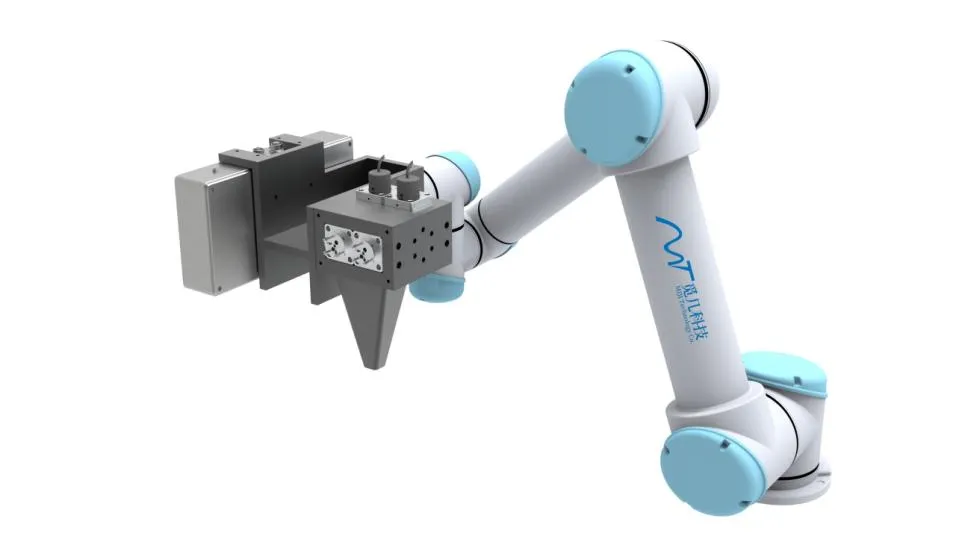
The core of this solution is to make the robotic arm the "precision executor" of terahertz testing: through a preset grid path-planning algorithm, the robotic arm can carry the terahertz time-domain spectroscopy probe and move uniformly along the mural surface, achieving automated area scanning with millimeter-level spacing and completely eliminating the subjective deviation of manual operation. For the uneven domes and rugged mural surfaces inside the grottoes, the robotic arm, with its multi-axis linkage and real-time position calibration functions, can flexibly adjust the scanning angle and distance, ensuring that the probe always maintains a safe distance from the murals — avoiding contact damage while guaranteeing signal stability at every sampling point.
What is even more noteworthy is the innovative "multi-technology synergy" design: the robotic arm not only carries terahertz equipment, but also integrates an X-ray fluorescence spectrometer (XRF) and a structured-light 3D scanner. In the practice at Cave 161 of Kizil, the robotic arm first uses structured-light scanning to obtain 3D topographic data of the murals, providing a spatial coordinate reference for terahertz and XRF testing; then the terahertz equipment penetrates the soot layer to capture time-domain signals from the pigment layer; finally, XRF analyzes the elemental composition of the pigments — the three datasets are integrated through automated algorithms to form a complete "structure + composition + image" detection chain.
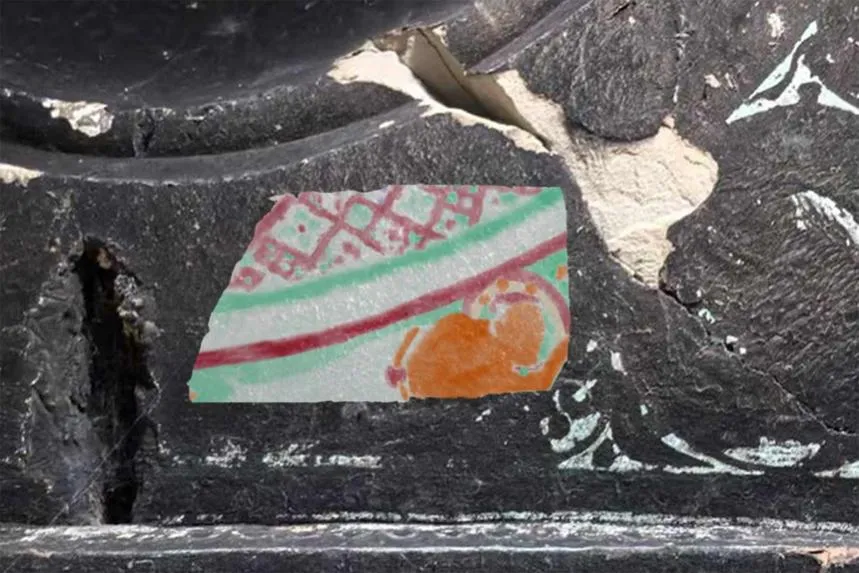
Relying on this system, the team achieved a technical breakthrough: for a 50 × 70 cm² smoke-damaged mural area in Cave 161, the robotic arm completed the entire workflow of multimodal coarse scanning and fine scanning, improving efficiency by more than 3 times compared with traditional manual inspection. Through terahertz signal denoising and peak-finding algorithms, the reflection peaks of the air/soot layer and soot/pigment layer interfaces were clearly identified; combined with XRF elemental distribution data, details such as the halo and belt of the celestial figure were precisely restored, and even the distribution characteristics of pigments such as cinnabar (Hg) and atacamite (Cu) were reconstructed — with restored image precision reaching 1 mm planar resolution and 10 µm depth resolution.
Chengdu Miji Technology's robotic-arm automated terahertz solution is not only suitable for grotto murals, but can also be flexibly adapted to various relic testing scenarios such as painted pottery, stone statues and ancient book bindings: for fine patterns on pottery surfaces, the robotic arm can achieve micron-level scanning; for the curved structures of large statues, the multi-axis linkage function ensures detection with no blind spots. The standardized path-planning algorithms and data processing modules also give the solution strong industry reusability, providing a replicable technical template for the protection of grotto sites such as Dunhuang and Maijishan.
From "manual exploration" to "automated precision detection", Chengdu Miji Technology has redefined the efficiency and accuracy of non-destructive testing of cultural relics through the innovative fusion of robotic arms and terahertz technology. In the future, we will continue to optimize equipment miniaturization and algorithm intelligence, making automation technology a "reliable partner" for cultural relic preservation and safeguarding the millennial elegance of every cultural heritage site!
Chengdu Miji Technology Co., Ltd. has long been committed to the localization of high-end terahertz equipment and near-field optical equipment. We will continue to follow international frontier developments in related fields and publish professional interpretations of related work — stay tuned. The company currently offers terahertz far-field imaging and time-domain spectroscopy systems, terahertz near-field imaging and spectroscopy systems, and terahertz photoconductive-probe near-field systems (micron-level resolution). Researchers interested in sample testing are welcome to contact us and send samples for testing.
Text | Hu Jinkang
Layout | Xiang Shaolian