What scientific sparks fly when free electrons meet a graphene hyperbolic grating?
With the rapid development of optoelectronic technology today, scientists have been searching for new types of light sources and detectors, especially in the terahertz band — the electromagnetic band between microwaves and infrared, which has enormous application potential but is difficult to generate and detect efficiently.
In recent years, research on the interaction between free electrons and graphene hyperbolic gratings has provided new possibilities for solving this problem. Today, let us step into this frontier scientific field and explore its mysteries.
1. What is a graphene hyperbolic grating?
To understand graphene hyperbolic gratings, we first need to break down two key concepts: graphene and hyperbolic materials.
1. Graphene: an exceptional two-dimensional material
Graphene is a two-dimensional honeycomb lattice structure formed by a single layer of closely packed carbon atoms, renowned for its ultimate electronic and optical properties:
- Extremely high carrier mobility, far exceeding traditional semiconductors;
- Conductivity can be flexibly adjusted through chemical doping, gate voltage, and other means;
- Combining transparency and conductivity, it is an ideal candidate material for optoelectronic devices.

2. Hyperbolic materials: anisotropic "light field regulators"
Hyperbolic materials are a special class of optical materials whose core feature is optical anisotropy: they exhibit completely different optical responses to light propagating in different directions. This property enables them to:
- Support highly localized optical modes;
- Confine light fields within extremely small volumes, significantly enhancing light-matter interactions.
3. Graphene hyperbolic grating: a structural innovation where 1+1>2
The graphene hyperbolic grating combines the advantages of both, and through periodic structural design, simultaneously achieves:
- Inheriting the "tunability" of graphene (conductivity and chemical potential can be regulated);
- Retaining the "strongly localized light field" characteristics of hyperbolic materials;
- Ultimately forming a new functional structure capable of efficiently controlling light propagation and radiation.
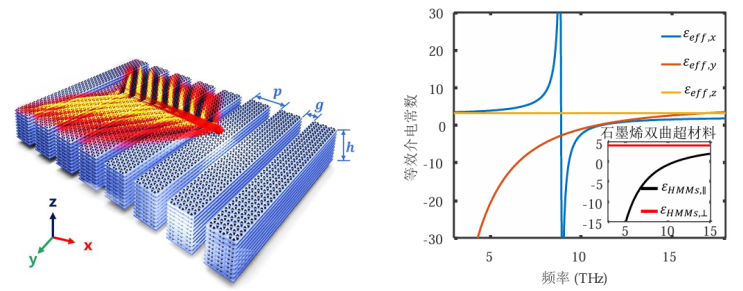
2. Interaction mechanism between free electrons and graphene hyperbolic gratings
When free electrons move near a graphene hyperbolic grating, they trigger a variety of physical phenomena, the most central and application-valuable of which is Cherenkov radiation, along with the derived "tunable optical topological transition".
1. Cherenkov radiation: from "nuclear reactor glow" to "chip-scale applications"
- Basic definition: Cherenkov radiation is the electromagnetic radiation emitted when a charged particle moves through a medium faster than the phase velocity of light in that medium. In daily life, the blue glow of nuclear reactors is a typical example of Cherenkov radiation;
- Traditional limitations: traditional Cherenkov radiation requires electrons to reach extremely high velocities, relying on large particle accelerators, and cannot be miniaturized;
- Breakthrough with graphene hyperbolic gratings: the research group of Professor Hu Min, from the team of Academician Liu Shenggang at the University of Electronic Science and Technology of China, found that in graphene hyperbolic gratings, efficient threshold-free Cherenkov radiation can be produced even at low electron velocities — a property that completely eliminates dependence on large accelerators and lays the foundation for chip-scale radiation sources.
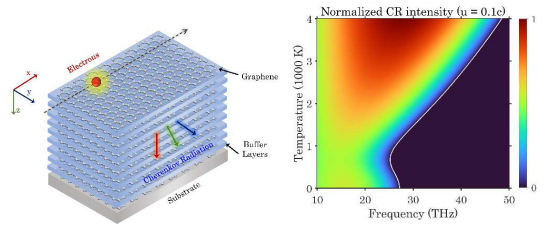
2. Tunable optical topological transition: dynamically controlling radiation characteristics
Even more exciting, the researchers observed a tunable optical topological transition phenomenon in the Cherenkov radiation of this system:
- By controlling the chemical potential of graphene via gate voltage, the angle and intensity of Cherenkov radiation can be directly changed;
- This "active control capability" makes dynamically reconfigurable terahertz sources possible, and is a core technical support for future programmable terahertz chips.
3. Breakthrough progress: from "out-of-plane radiation" to "in-plane radiation"
In the research on the interaction between free electrons and graphene hyperbolic gratings, the "transition of radiation direction" is a milestone breakthrough that directly promotes integrated applications.
1. Early research: limitations of out-of-plane radiation
Early research focused on out-of-plane radiation (radiation emitted perpendicular to the material surface), but this radiation mode has obvious shortcomings:
- Difficult to couple with integrated structures such as on-chip waveguides and photonic chips;
- Limited radiation power, unable to meet high-demand scenarios.
2. Key breakthrough: realization of in-plane radiation (2021)
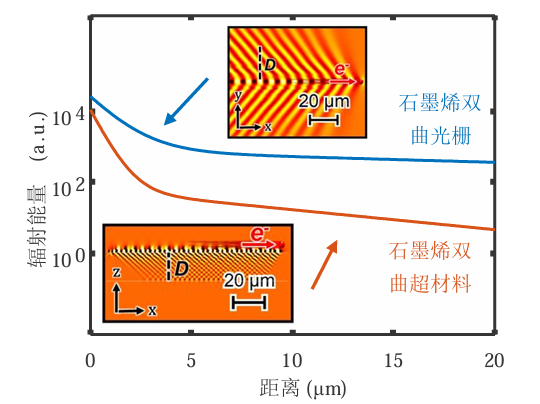
The research group at the University of Electronic Science and Technology of China was the first in the world to theoretically propose and verify "in-plane efficient threshold-free Cherenkov radiation in graphene hyperbolic gratings", bringing two core advantages:
- Power increase: the in-plane radiation power is nearly two orders of magnitude higher than traditional out-of-plane radiation;
- Integration-friendly: in-plane radiation can be directly coupled with on-chip waveguides and integrated photonic structures, clearing a key obstacle for "fully integrated terahertz chips".
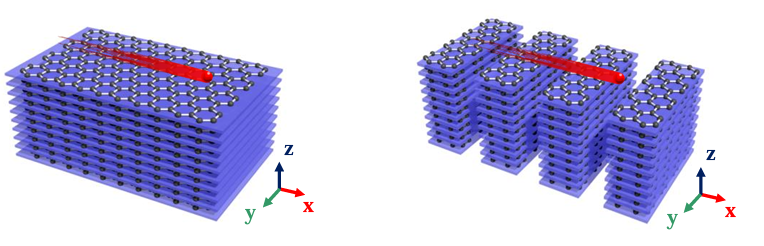
4. Technical advantages and application prospects
The interaction between free electrons and graphene hyperbolic gratings has attracted widespread attention because of its irreplaceable technical advantages and broad application scenarios.
1. Three core technical advantages
- High efficiency: it can efficiently convert the kinetic energy of free electrons into terahertz radiation, with a conversion efficiency far exceeding traditional terahertz sources (such as quantum cascade lasers and photoconductive antennas);
- High tunability: full-dimensional control is achieved in three ways — adjusting the graphene chemical potential (gate voltage), the grating structural dimensions, and the free electron velocity — allowing precise control of the radiation angle, intensity, and frequency, which traditional light sources cannot achieve;
- Miniaturization and integration: no large accelerator is needed, and the radiation source can achieve chip-scale dimensions, making it possible for terahertz technology to move from the "laboratory" into "daily life".
2. Four application prospects
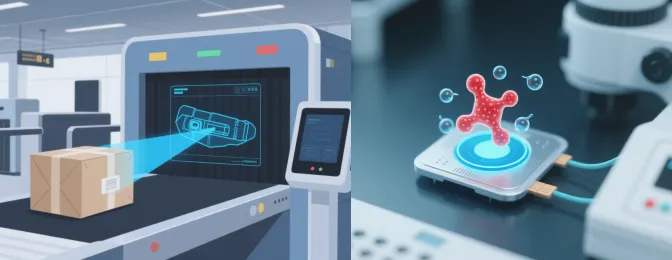
- Terahertz radiation sources: for security inspection (such as contraband imaging), medical imaging (no ionizing radiation), and non-destructive testing (industrial material defect detection);
- High-sensitivity sensors: exploiting the high sensitivity of the radiation to the dielectric environment to achieve trace substance detection (such as biomolecules and toxic gases);
- Broadband photodetectors: covering broad-spectrum detection from ultraviolet to terahertz, usable for astronomical observation and environmental monitoring;
- Quantum information devices: twisted bilayer graphene in this system can be used to construct dual-qubit devices, providing a new carrier for quantum computing and quantum communication.
5. Challenges and outlook
Despite significant research progress, this field still needs to break through three core challenges before industrialization can be achieved.
1. Current challenges
- Manufacturing precision: graphene hyperbolic gratings require nanoscale fabrication precision (feature sizes typically <100 nm), and large-scale, low-cost, high-consistency fabrication processes are not yet mature.
- Thermal management: the interaction between free electrons and the grating generates heat; if heat dissipation is not timely, it will cause graphene performance degradation and shortened device lifetime.
- System integration: how to efficiently integrate the new radiation source with existing electronic systems (such as drive circuits) and optical systems (such as lenses and waveguides) still requires further exploration.
2. Development history and future outlook
The pace of development in this field is remarkable. Key milestones include:
- 2012: The team of Academician Liu Shenggang at the University of Electronic Science and Technology of China first revealed the mechanism of "coherent enhanced Cherenkov radiation in the visible band generated by free electrons exciting metal surface plasmons";
- 2017: The world's first experimental observation of "reversed Cherenkov radiation";
- 2021: Realization of "in-plane efficient threshold-free Cherenkov radiation".
In the future, with breakthroughs in manufacturing processes, thermal management technology, and integration solutions, this research will bring disruptive innovations to terahertz technology, integrated photonics, and quantum information technology.
6. Conclusion
Research on the interaction between free electrons and graphene hyperbolic gratings is a deep fusion of traditional free electron physics and frontier two-dimensional materials science. It not only deepens humanity's understanding of "light-matter interaction", but also provides innovative paths for solving the three core problems of terahertz technology: "efficient generation, precise control, and integrated application".
Perhaps in the near future, terahertz chips based on this technology will be as widespread as today's microprocessors, changing our lives once again — from safer security checks and more accurate medical diagnoses to faster quantum communication, all made possible by it.
References
··
[1] Zhang Tianyu et al., "Tunable optical topological transition of Cherenkov radiation", Photonics Research, 2022
[2] Zhang Xiaoqiuyan. Research on terahertz radiation generated by free-electron-excited metamaterials[D]. University of Electronic Science and Technology of China, 2022
[3] A graphene dual-period grating sensor for the infrared band, Chinese patent
[4] Li Guanhai et al., "Toroidal Dipole BIC-Driven Highly Robust Perfect Absorption with a Graphene-Loaded Metasurface", Nano Letters, 2023
[5] Zhang Yipeng et al., "Research progress of graphene-based photodetectors under different response mechanisms", Chinese Journal of Luminescence, 2022
[6] Ardenghi, J. S., "Effective interactions in twisted double-layer graphene in a microcavity", Journal of Physics: Condensed Matter, 2020
-END-
Text|Zhang Siyuan
Layout|Xiang Shaolian