The team of Professor Hu Min — founder of Chengdu Miji Technology Co., Ltd. and professor at the Terahertz Center of UESTC — collaborated with the team of Dr. Hu Tao from West China Hospital of Stomatology to study the microscopic mechanism of early-stage tooth demineralization using a terahertz scattering-type scanning near-field optical microscope system (s-SNOM). Enamel demineralization occurs in the early stages of dental caries and has long been a topic of concern for dentists. Understanding its fundamental mechanism is of great significance for the prevention and treatment of caries. However, limited by the resolution and detection capabilities of diagnostic tools, the study of enamel demineralization has remained a challenge. Terahertz technology — particularly the combination of scanning near-field optical microscopy with terahertz time-domain spectroscopy — shows great advantages in biological imaging thanks to its nanoscale resolution. The Chengdu Miji Technology team has been deeply engaged in the terahertz field, committed to the localization of high-end terahertz equipment and near-field optical equipment. The company is mainly engaged in the research, production and sales of terahertz-related instruments, as well as domestic and international technology and product trade agency services.
The research results were published in the journal Biomedical Optics Express under the title "Unveiling enamel demineralization mechanisms by sensitive dielectric differentiation based on terahertz nanospectroscopy", revealing the application potential of this technology in oral medicine — in particular, its breakthrough in microscopic detection of tooth demineralization. Team members include Dr. Xiao Feng, postdoctoral researcher Zhang Xiaoqiuyan, Dr. Xu Xingxing, postdoctoral researcher Zhang Tianyu, Dr. Tang Fu, master's student Yin Haowei and Professor Hu Min from UESTC, as well as Dr. Cheng Li, Dr. Lei Lei and Dr. Hu Tao from West China Hospital of Stomatology.
Technological innovation: breaking through resolution limits to achieve micro-nano resolution biological spectral imaging:
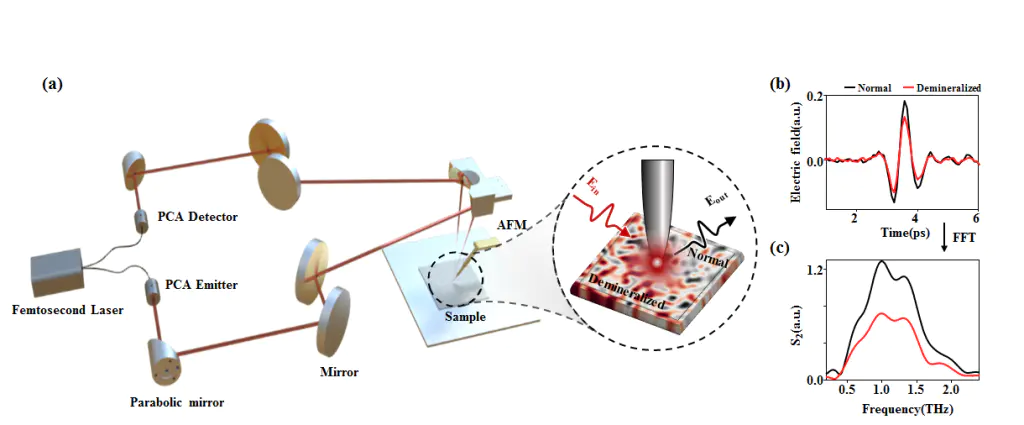
Terahertz waves are widely used in data communications, security, biomedical imaging and other fields thanks to their excellent properties. This study employs the latest terahertz s-SNOM technology, leveraging its sensitivity to changes in dielectric constant to investigate the microscopic mechanism of tooth demineralization. Compared with conventional atomic force microscopy (AFM) and scanning electron microscopy (SEM) techniques, terahertz s-SNOM can observe the morphological and structural changes of demineralized enamel under the microscope, providing a new method for early detection of tooth demineralization and monitoring of its progression. (A schematic of the system is shown in Figure 1.)
Near-field spectral imaging of tooth demineralization: revealing the microscopic mechanism
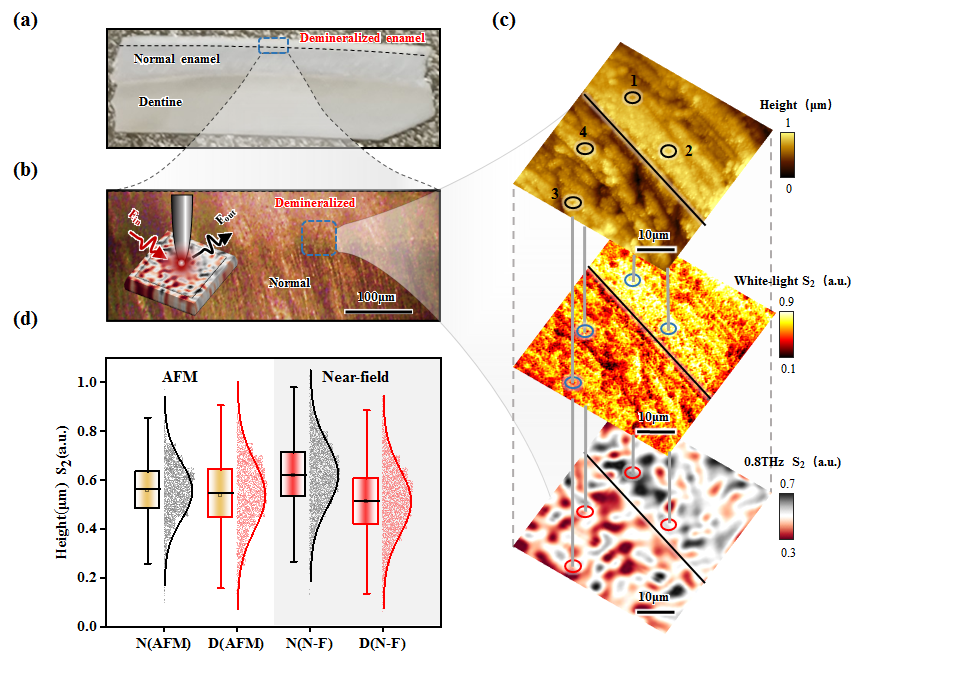
Using this technique to characterize demineralized enamel (imaging results shown in Figure 2): AFM results show significant changes in height fluctuation after demineralization; both near-field maximum and frequency-domain imaging results show that the amplitude decreases substantially in the demineralized area, with clear differences between pre- and post-demineralization regions. On this basis, the correlation between AFM and near-field data in normal and demineralized regions was further analyzed. For the AFM results, the overall average height changed little after demineralization; however, due to changes in the crystal structure, the up-and-down fluctuations became severe. For the near-field results, the near-field signal in the demineralized area decreased uniformly overall compared with the normal area. Because the terahertz near-field signal is sensitive to the dielectric properties of the sample, the change in near-field signal amplitude indicates that the terahertz dielectric properties of the enamel changed significantly. This is caused by lattice changes and the migration of mineral ions during demineralization, which lead to a decrease in the dielectric constant of the enamel. The new method presented in this paper reveals the nature of demineralization and lays a foundation for further research and potential interventions.
Future outlook: advancing terahertz imaging technology in biomedical applications
This study used a terahertz scattering-type near-field scanning microscope system to perform near-field imaging of enamel before and after demineralization, demonstrating changes in the surface structure and dielectric properties of demineralized enamel and revealing the nature and mechanism of enamel demineralization. The study demonstrates the application prospects of terahertz near-field technology for dental hard tissues, providing a technique capable of detecting early enamel demineralization and monitoring its progression. In the future, with the further development of higher-power and broadband terahertz sources and high-performance near-field probes, this technology can become an even more powerful tool for studying the microstructure and mechanisms of dental hard tissues, better complementing the X-ray and scanning electron microscopy techniques used in conventional oral medicine, and further advancing the development of terahertz imaging technology in biomedical applications.
Chengdu Miji Technology Co., Ltd. has long been committed to the localization of high-end terahertz equipment and near-field optical equipment, and is mainly engaged in the research, production and sales of terahertz-related instruments, as well as domestic and international technology and product trade agency services. The company will continue to follow international frontier developments in related fields and publish professional interpretations of related work — stay tuned. The company currently offers terahertz far-field imaging and time-domain spectroscopy systems, terahertz near-field imaging and spectroscopy systems, and terahertz photoconductive-probe near-field systems (micron-level resolution). Researchers interested in sample testing are welcome to contact us and send samples for testing.