Author: Nie Mengxue
Background
Metamaterials are a class of special composite materials or structures that emerged in the 21st century. Typically composed of metals and dielectric materials, they acquire extraordinary physical properties unavailable in conventional materials through orderly structural design of key physical dimensions. Spanning numerous disciplines, metamaterials are among the most cutting-edge and strategically significant research topics in the world today, attracting worldwide attention. Both Science and Materials Today have spoken highly of metamaterial research, listing it as one of the most significant scientific advances in materials science in recent decades. At present, metamaterials find remarkable applications across many fields, and metamaterial research has become one of the hottest topics in academia.
Specifically, a metamaterial is an artificially designed periodic structure whose unit-cell size is generally smaller than the wavelength of the operating band, and which exhibits specific electromagnetic properties compared with natural materials. Metamaterial design is deliberate and goal-oriented, intended to meet technical requirements for specific scenarios. A metasurface is a two-dimensional metamaterial, generally built from metallic or dielectric materials with a two-dimensional periodic structure, and is currently the hottest area of metamaterial research. By designing the shape, size, and other parameters of the unit cells, a metasurface can achieve diverse manipulation of electromagnetic fields, such as polarization control, reflection control, and absorption control. Beyond that, metasurfaces are used in many studies of idealized conditions, such as electromagnetic cloaking in aerospace [17] and perfect absorbers in materials science. Compared with natural materials, metamaterials therefore offer irreplaceable advantages in electromagnetics. With their compact size, high efficiency, and broad operating bandwidth, they have become candidate materials for the development of terahertz devices.
The concept of metamaterials was first proposed by Veselago in 1967 [1], who theoretically predicted a material with a negative refractive index. He pointed out that when both the permittivity and permeability of a material are negative, the electric field vector, magnetic field vector, and wave vector no longer obey the right-hand rule, forming instead a "left-handed material." Owing to limitations in experimental conditions at the time, this was not verified or further studied. It was not until 30 years later that British physicist Pendry proposed a cylindrical metallic wire array structure [2] and experimentally observed that it could produce a negative effective permittivity, confirming Veselago's view; he subsequently designed the classic split-ring resonator model with negative permeability [3]. From then on, the metamaterial concept was experimentally confirmed and research flourished. In the microwave band, the first truly artificially designed and fabricated metamaterial was the left-handed material designed by Smith et al. in 2000 [4]. It consisted of two concentric circular split-ring resonators whose openings were oriented 180° apart, and experiments showed negative effective permittivity and permeability over the 0.1–8 GHz band, as shown in Figure 1. Owing to these special properties, many metamaterial-based devices have emerged, including phase shifters that control the phase of electromagnetic waves, perfect absorbers that absorb electromagnetic waves with virtually no transmission or reflection, and polarization converters that control the polarization direction of electromagnetic waves.
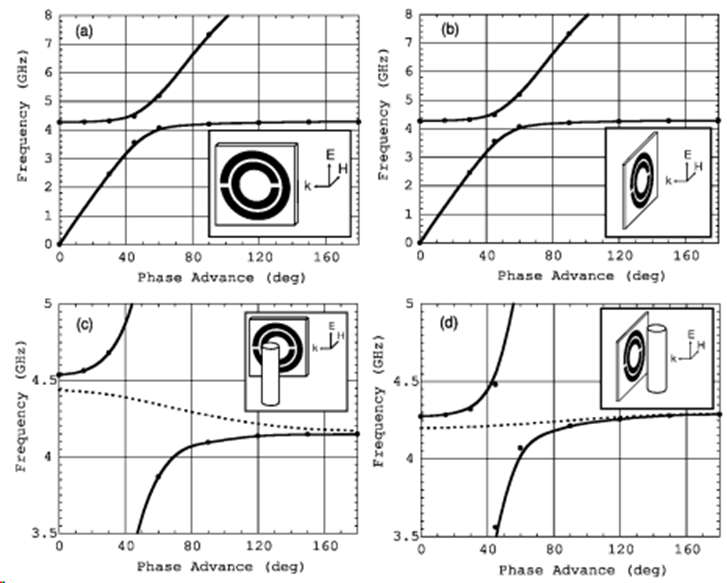
Figure 1. Microwave-band metamaterial with negative refractive index and permeability [4]
A polarization converter, as the name implies, is a device that changes the polarization state of an electromagnetic wave—converting an incident wave from linear to circular polarization, or from one linear polarization direction to another. In engineering, the most intuitive application of polarization conversion is the polarizer: when a wave of a specific polarization direction is needed, the polarizer filters out waves of other polarization directions or converts them into the desired direction. By operating type, polarization converters can be divided into reflective and transmissive polarization converters.
Terahertz Reflective Metamaterial Polarization Converters
A reflective polarization converter usually consists of three layers: an upper metasurface metal layer, a middle dielectric layer, and a bottom metal ground plane. The upper metasurface metal is the primary cause of polarization conversion, while the bottom metal plane reflects the electromagnetic wave. The application of metamaterials to terahertz polarization converter design can be traced back to 2013, when N. K. Grady et al. [5] designed a reflective metasurface periodic structure achieving polarization conversion in the terahertz band: an upper layer of metallic short-wire structures performs the polarization conversion, a solid metal bottom layer reflects the terahertz wave, and a dielectric layer separates them, as shown in Figure 2(a). When an X-polarized terahertz wave is incident, dipole resonance at the metallic short wires changes the polarization direction, and the reflected wave exhibits a cross-polarized component. Meanwhile, because the upper metasurface and the lower metal plate form a Fabry–Pérot (F-P) resonant cavity, multiple interference suppresses transmission of the X-polarized wave, achieving broadband reflective polarization conversion over 0.8–1.8 THz, as shown in Figure 2(b).
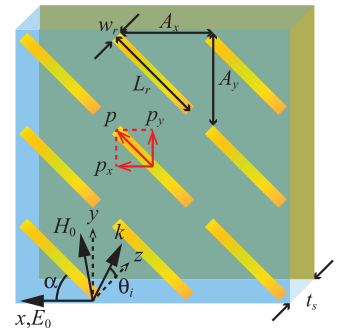
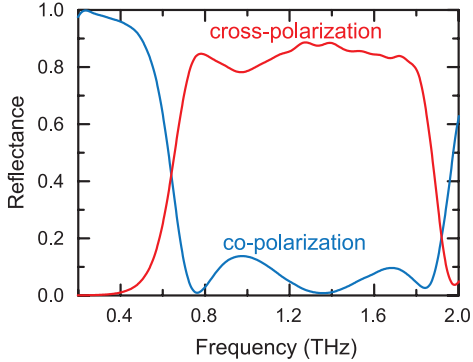
Figure 2. Reflective metasurface results
(a) Schematic of the metallic short-wire array reflective polarization converter; (b) co-polarized and cross-polarized reflection amplitudes [5]
In 2014, Cheng Yongzhi et al. [6] designed an ultra-thin, ultra-broadband, high-efficiency terahertz reflective polarization converter. The device consists of an upper metamaterial metal layer, a middle dielectric layer, and a bottom metal layer, where the upper metasurface adopts a periodic structure combining metallic disks and double split-ring resonators, achieving X–Y polarization conversion over 0.65–1.45 THz, as shown in Figure 3(a). Experimental and simulation results agree well, as shown in Figure 3(b). In 2017, Xia Rui et al. [7] proposed a terahertz half-wave plate achieving broadband reflective linear polarization conversion. Its upper metasurface unit cell uses two pairs of patches forming a 45°-symmetric double-V structure, with a solid metal ground plane below and a dielectric layer in between. This structure exhibits three polarization conversion peaks over 0.65–1.6 THz, with a polarization conversion ratio (PCR) approaching 100%. In 2019, Guan Shengnan et al. [8] proposed a hybrid graphene–dielectric metasurface that tunes the Fermi level of graphene via an external voltage, ultimately enabling switching between a reflective terahertz half-wave plate and a quarter-wave plate around 1 THz. This work transformed reflective terahertz polarization converters from passive into active devices.
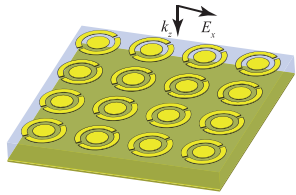
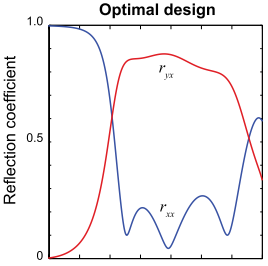
Figure 3. Reflective metasurface results
(a) Schematic of the disk-and-split-ring array reflective polarization converter; (b) co-polarized and cross-polarized reflection coefficients
Terahertz Transmissive Metamaterial Polarization Converters
In addition to the reflective converters introduced above, terahertz transmissive polarization converters have also been a research focus in recent years, mainly because transmissive converters offer relatively higher application value and broader applicability in optical engineering. There are two common types of transmissive polarization converters: one is a two-layer structure with an upper metasurface metal layer and a lower dielectric substrate; the other is a three- or five-layer structure in which grating layers are added on the top and bottom surfaces of the two-layer structure (when a grating is added on the top surface, a dielectric layer must also be inserted between the metasurface and the grating). The purpose of the grating layers is to ensure the purity of the polarization directions of the incident and outgoing waves. In 2011, N. Yu et al. designed a V-shaped metallic periodic metasurface; by adjusting the parameters of the surface metal structure, they achieved conversion between electromagnetic modes, exciting two electromagnetic modes whose electric-field polarization directions are perpendicular to the incident electric field [9]. In 2013, N. K. Grady et al. [5], while designing their reflective metasurface polarization converter, also explored a transmissive design based on the same metasurface: metallic wire-grid structures are added to the top and bottom surfaces with dielectric spacers between the metal structures, the two wire grids being mutually perpendicular and oriented at 45° to the metasurface structure, as shown in Figure 4(a). Owing to the polarization selectivity of the gratings, the incident wave contains almost only X-polarized components, while only Y-polarized waves are detected at the output, demonstrating X–Y polarization conversion. In the same year, S. Wu et al. [10] designed a transmissive terahertz metamaterial polarization converter by periodically etching a chiral S-shaped array into the upper metal film, using localized plasmonic resonance in the metallic slits to convert linear polarization into elliptical polarization in transmission. In 2015, W. Liu et al. [11] proposed a single-layer transmissive metasurface polarization converter, likewise using periodically etched chiral metal structures, achieving nearly 90% linear cross-polarization conversion over 0.92–1.39 THz. Their metasurface design is an improvement based on double split square-ring resonators, as shown in Figure 4(b).
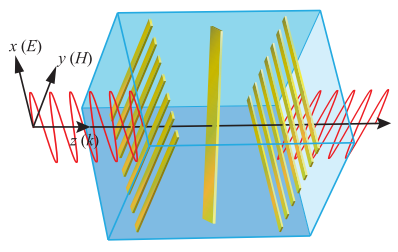
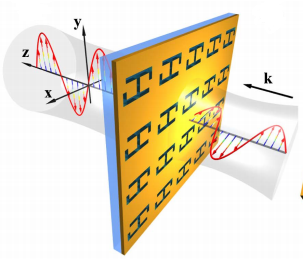
Figure 4. Transmissive metasurface structures: (a) metallic short-wire array; (b) H-like array
In 2017, S. T. Xu et al. [12] designed a multilayer metasurface with a gradient grating on top, an H-shaped metasurface below, and a dielectric layer inserted between them, exploiting the birefringence of the grating and the terahertz polarization sensitivity of the rear metasurface to realize a bidirectional transmissive polarization converter. In 2018, X. Jing et al. [13] designed a bilayer metasurface using an upper bracket-shaped layer (mainly for polarization conversion) and a lower grating layer, achieving a broadband 99% polarization conversion efficiency over 0.55–1.37 THz, and explained the conversion enhancement mechanism with a Fabry–Pérot-like cavity model. The structure and conversion amplitudes are shown in Figure 5.
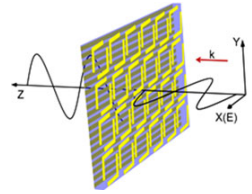
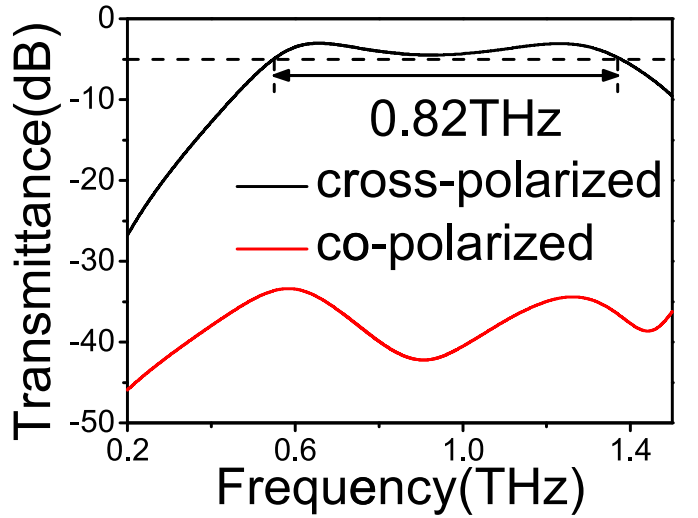
Figure 5. Bracket-shaped transmissive metasurface results: (a) schematic of the bracket-array transmissive polarization converter; (b) co-polarized and cross-polarized transmission amplitudes
In 2020, Zi-Yang Zhang et al. [14] used a double-layer chiral metamaterial for PVA film thickness sensing, mainly exploiting the polarization-selective transmission of the metamaterial and the thickness sensitivity of the F-P cavity. In 2022, Y. Zhang et al. [15] designed a multilayer composite metasurface in which front and rear gratings ensure a single polarization direction while a central cross-shaped structure performs polarization conversion (Figure 6(a)), ultimately achieving ultra-broadband X–Y polarization conversion with nearly 100% efficiency over 0.41–2.38 THz in the terahertz band, with bidirectional transmission. More recently, Liu Jingyu et al. [16] demonstrated broadband linear polarization conversion in the terahertz band with a composite V-shaped metasurface, and X. Jiang et al. [17] combined a polarization-conversion metasurface with anisotropic liquid crystal to investigate the controllability of its conversion performance; the structure is shown in Figure 6(b).
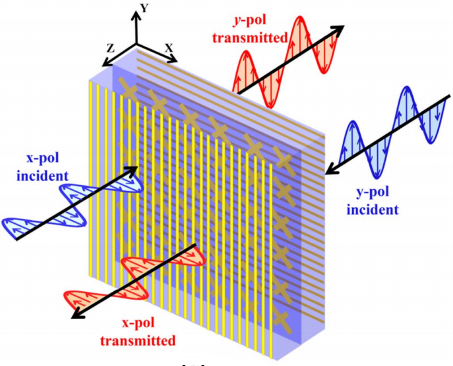
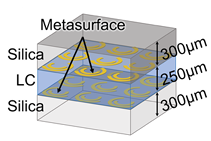
Figure 6. Transmissive metasurface structures: (a) multilayer composite metasurface [15]; (b) liquid-crystal–metal metasurface [17]
Conclusion
As one of the hottest topics in scientific research in recent years, metamaterials span every band of the electromagnetic spectrum and are widely used in a variety of application-oriented devices. As an emerging research direction, the combined study of metamaterials and terahertz technology holds significant research value and broad prospects. The study of terahertz polarization properties of novel materials has long been a focus of the terahertz field, and artificial structural design enables materials to perform polarization conversion in the terahertz band. Research on terahertz metamaterial polarization converters is now thriving, and an increasing share of work is no longer confined to conventional metallic metamaterial device design; instead, researchers are combining various functional materials with metamaterials to design terahertz polarization converters with higher performance, higher integration, and stronger tunability. In the future, research on terahertz metamaterial polarization converters will continue to develop toward broadband operation, tunability, and multifunctional integration, finding ever more diverse applications in terahertz communications, imaging, and beyond—leading the innovation of terahertz devices.
References
- Veselago V G. The Electrodynamics of Substances with Simultaneously Negative Values of ε and µ[J]. Soviet physics uspekhi, 1968,(10): 509–514
- Pendry, JB, Holden, AJ, Stewart, WJ, and Youngs. "Extremely Low Frequency Plasmons in Metallic Mesostructures." Physical Review Letters 76.25 (1996): 4773-776. Web.
- Porto J A, García-Vidal F J, Pendry J B. Transmission Resonances on Metallic Gratings with Very Narrow[J]. Phys Rev Lett, 1999,(83): 2845–2848
- Smith D R, Padilla W J, Vier D C, et al. Composite medium with Simultaneously Negative Permeability and Permittivity[J]. Phys Rev Lett, 2000,(84): 4184–4197
- Nathaniel K. Grady et al. ,Terahertz Metamaterials for Linear Polarization Conversion and Anomalous Refraction.Science340,1304-1307(2013).DOI:10.1126/science.1235399
- Cheng Y Z, Withayachumnankul W, Upadhyay A, et al. Ultrabroadband reflective polarization convertor for terahertz waves[J]. Applied Physics Letters, 2014, 105(18): 181111.
- Xia R, Jing X, Gui X, et al. Broadband terahertz half-wave plate based on anisotropic polarization conversion metamaterials[J]. Optical Materials Express, 2017, 7(3): 977–988.
- Shengnan Guan, Jierong Cheng, Tiehong Chen, and Shengjiang Chang, "Widely tunable polarization conversion in low-doped graphene-dielectric metasurfaces based on phase compensation," Opt. Lett. 45, 1742-1745 (2020)
- Nanfang Yu et al. ,Light Propagation with Phase Discontinuities: Generalized Laws of Reflection and Refraction.Science334,333-337(2011).DOI:10.1126/science.1210713
- Wu, Shan, et al. “Enhanced Rotation of the Polarization of a Light Beam Transmitted through a Silver Film with an Array of Perforated S-Shaped Holes.” Physical Review Letters, vol. 110, no. 20, 2013, p. 207401.
- Liu, Wenwei, et al. “Realization of Broadband Cross-Polarization Conversion in Transmission Mode in the Terahertz Region Using a Single-Layer Metasurface.” Optics Letters, vol. 40, no. 13, 2015, pp. 3185–3188.
- Xu, Shi-Tong, et al. “Terahertz Polarization Mode Conversion in Compound Metasurface.” Applied Physics Letters, vol. 111, no. 3, 2017, p. 31107.
- Jing, Xufeng, et al. “Physical Explanation of Fabry–Pérot Cavity for Broadband Bilayer Metamaterials Polarization Converter.” Journal of Lightwave Technology, vol. 36, no. 12, 2018, pp. 2322–2327.
- Zhang, Zi-Yang, et al. “Terahertz Polarization Conversion and Sensing with Double-Layer Chiral Metasurface.” Chinese Physics B, vol. 29, no. 7, 2020, p. 78707.
- Zhang, Y., Luan, W., Yan, X. et al. Ultra-broadband asymmetric transmission and linear polarization conversion based on terahertz metamaterials. Appl. Phys. B 128, 156 (2022).
- Liu J Y, Li W Y, Liu Z X, et al. Transmission-type terahertz linear polarization converter based on V-shaped metasurface[J]. Acta Physica Sinica, 2022, 71(23): 43-48.
- Xinhao Jiang, Yunyun Ji, Fei Fan, Huijun Zhao, Songlin Jiang, Jierong Cheng, Maoqi Wu, John H. Xin, and Shengjiang Chang, "Terahertz polarization and chirality modulation induced by asymmetry inversion combining chiral metasurface and liquid crystal anisotropy," Opt. Lett. 48, 1682-1685 (2023)