— A team from the Aerospace Information Research Institute (AIR), Chinese Academy of Sciences, has proposed “terahertz thermal absorption analysis”: it does not damage the sample and requires no prior knowledge of non-aqueous components.
Water may seem ordinary, yet it profoundly influences biological activity, tissue state, and industrial quality. But “measuring water accurately” is not easy: high-precision methods often require sample destruction, while spectroscopic methods are susceptible to scattering, limited penetration depth, and complex sample composition. Recently, a team from the Aerospace Information Research Institute, Chinese Academy of Sciences proposed “terahertz thermal absorption analysis,” which exploits the difference in temperature responses between water and non-aqueous components and directly retrieves water content through a “slope ratio,” offering a new route to nondestructive quantitative water measurement without prior compositional knowledge. 01 Measuring Water: What Exactly Makes It Difficult? Water content correlates with viral replication capacity and antibiotic sterilization efficacy, serves as an important indicator for distinguishing healthy from cancerous tissues, and directly affects food flavor and shelf life. Unfortunately, traditional water measurement techniques each have their own drawbacks: Dry-weight method and Karl Fischer titration: accurate, but destructive and time-consuming, and difficult to provide spatial distribution information; Near-infrared spectroscopy: susceptible to scattering and compositional variation, requiring complex calibration models; Infrared spectroscopy: penetration depth of only tens of micrometers, limiting its application depth; Raman spectroscopy: weak scattering signal and long integration time, usually only semi-quantitative.02 Terahertz Waves: Naturally Sensitive to Water
Terahertz waves (0.1–10 THz) are highly sensitive to water. In the terahertz band, the hydrogen-bond network of water has two major relaxation processes (around 20 GHz and 640 GHz), giving rise to strong absorption. Non-aqueous molecules such as sugars, lipids, proteins, and DNA show relatively low absorption and lack distinct spectral features in this frequency range. In addition, because the sub-millimeter wavelength reduces scattering effects and the quasi-optical characteristics are favorable for imaging, terahertz naturally offers advantages as a “water probe.” The challenge is that existing terahertz water measurement methods mostly rely on effective medium theory (EMT) and require prior knowledge of the dielectric constant of the non-aqueous components. To obtain these parameters, samples often have to be completely dehydrated first—this not only damages the sample but may also induce structural changes such as protein denaturation. Core difficulty: The water signal is not hard to observe; the hard part is eliminating the dependence on prior information about the non-aqueous components.03 Breakthrough: No “Composition Identification”—Only Temperature Response
Researchers identified a key difference: water and non-water components respond differently to temperature changes. Over the experimental temperature range, the terahertz absorption of water increases monotonically and approximately linearly with temperature, because the hydrogen-bond network is temperature-sensitive; the terahertz absorption of non-water components changes very little with temperature and exhibits an extremely weak temperature dependence. This means that by measuring the slope of the sample absorption versus temperature and dividing it by the slope of pure water, the water volume fraction can be obtained: water content = S(sample)/S(pure water). In other words, temperature variation effectively gives water a “recognizable label,” while the non-water background is substantially suppressed in the slope comparison.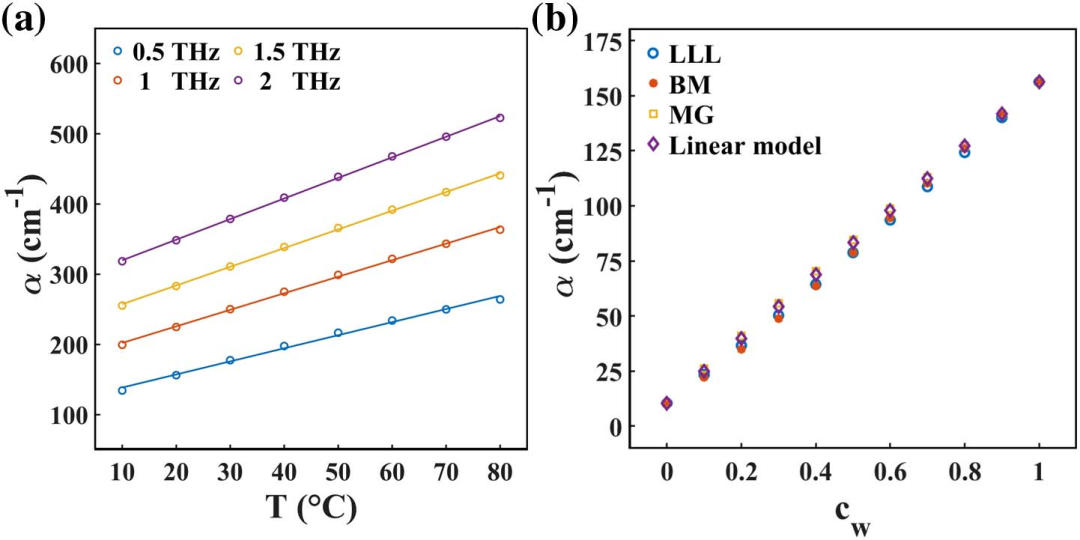
04 Method: Just Three Steps
The entire measurement workflow can be condensed into three steps: ① Dual-temperature-point measurement: Select two temperature points within a narrow temperature range of less than 10 °C, and measure the terahertz absorption of the sample. ② Extract the slope: Perform a linear fit on the absorption–temperature relationship to obtain the sample's absorption–temperature slope. ③ Normalized inversion: Divide the sample slope by the pure water slope to directly obtain the water content, without needing to know in advance what other components are present in the sample.05 Validation: From Solution to Gel, Results Highly Consistent with Formulated Values
The researchers first validated the method using BSA solutions and gelatin gels with precisely controllable water content. The formulated/measured values were 82.46%/82.32% for BSA and 67.31%/66.55% for gelatin, respectively. Within the water content range of 67%–97%, the method achieved a precision of 0.85%.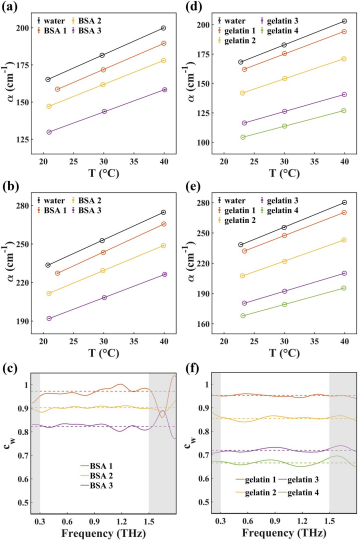 Figure 2: Absorption–temperature relationships and slope ratios for BSA and gelatin at different concentrations; experimental results are highly consistent with theoretical values.
06 Application 1: Complex biological tissues can also be “water-tested”
When the method was applied to more complex biological tissues, the results remained broadly consistent with the dry-weight method: pig muscle 75.60%/73.15%, skin 69.00%/65.49%, and fat 8.80%/6.82%. Among these, the discrepancy for skin samples mainly stems from a limitation of the dry-weight method—residual fat on the underside of the skin is difficult to remove completely, which lowers the water content obtained by the dry-weight method—whereas terahertz reflects the local water content of the measured area.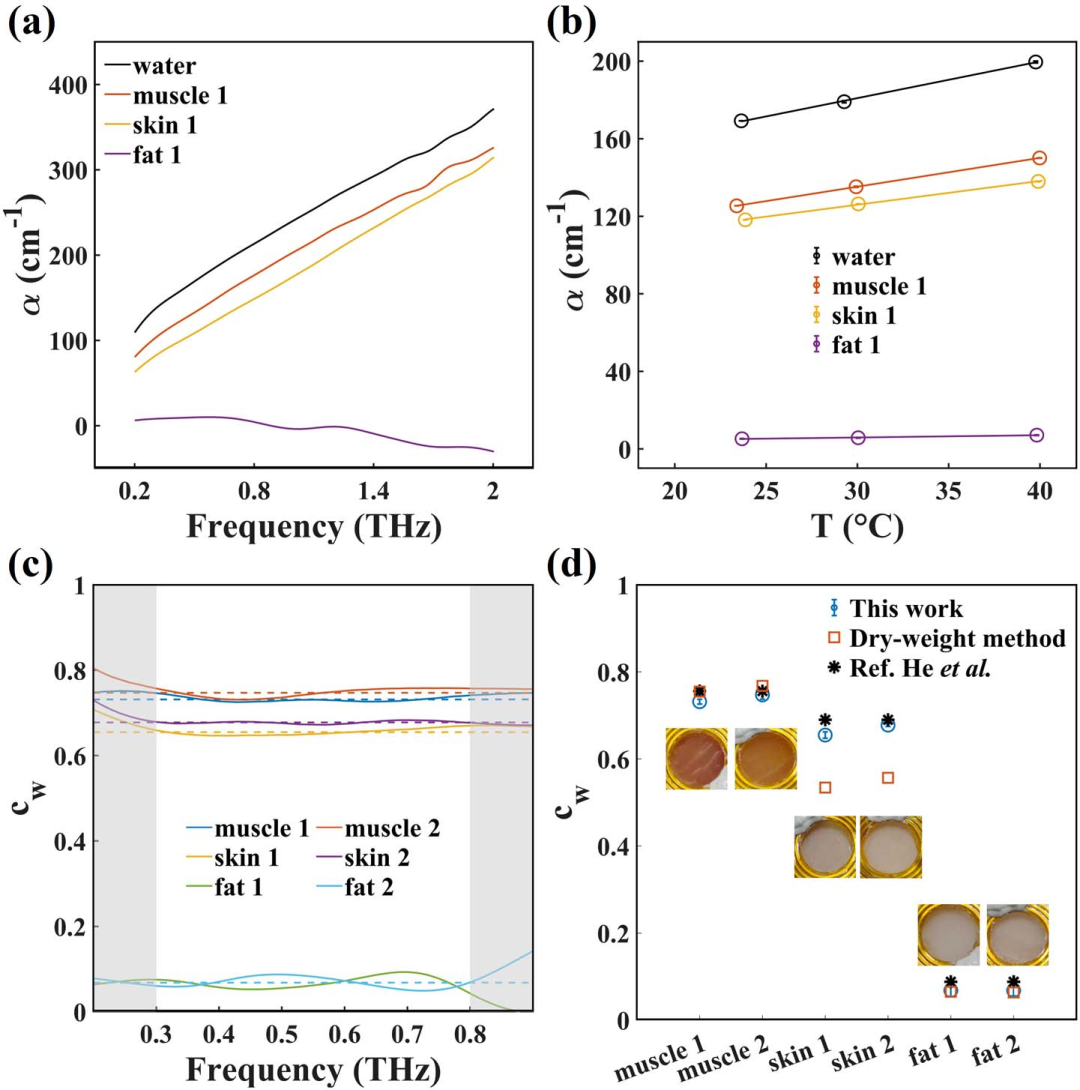
07 Application 2: Mapping Moisture Content in Leaves
Furthermore, this method can non-destructively map the spatial distribution of water. In the experiment, the researchers covered half of a banyan leaf with tape and placed it in a 37 °C incubator for 12 hours to accelerate dehydration, creating an uneven water distribution. Looking only at the original absorption image, the difference between the two sides is not obvious; however, after inversion into a water content map using the 'slope ratio', the contrast is significantly enhanced, the water loss in the uncovered area is clearly visible, and the difference in dehydration resistance in the lateral vein area is also revealed. Another important advantage is that the attenuation caused by scattering essentially does not vary with temperature, and can therefore be automatically canceled out in differential processing. As a result, the water content image is 'cleaner' than the original absorption image and is also more sensitive to spatial differences in water.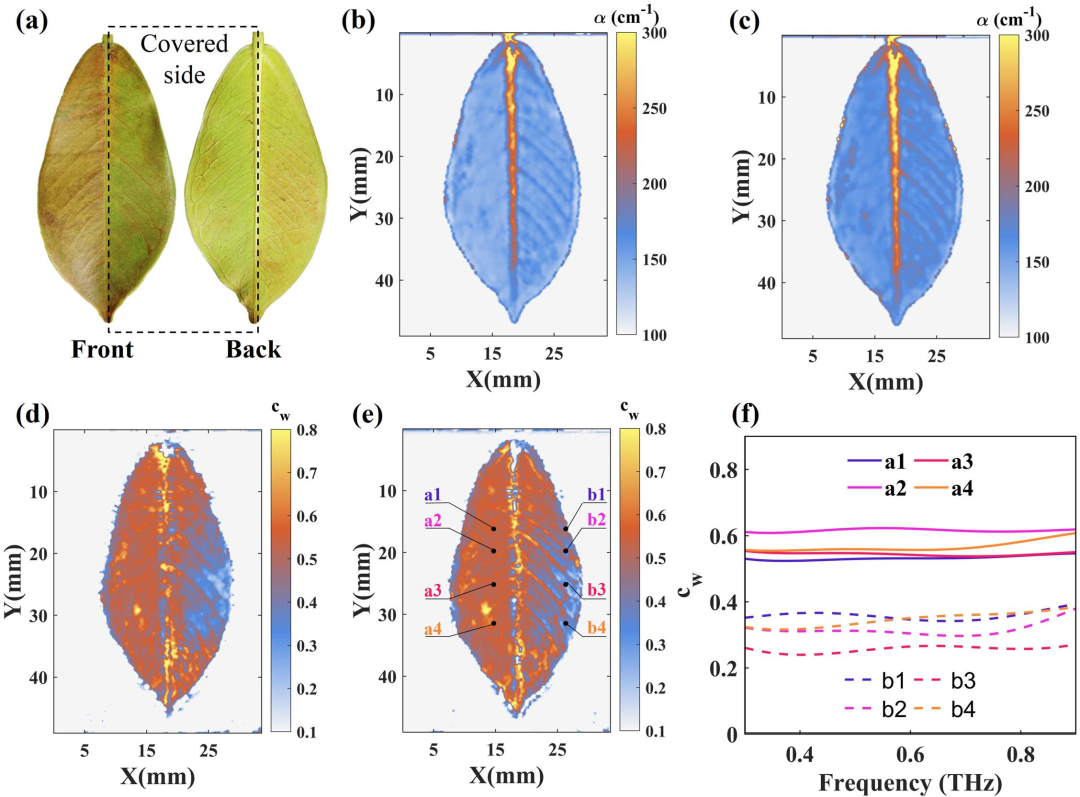
08 Three Advantages and Next Steps
The paper summarizes the advantages of this method into three points: Broad applicability: it has been validated in solutions, gels, animal tissues, and plant leaves, covering a moisture range of 7%–97%; Minimal thermal disturbance: inversion requires only two temperature points within a temperature window of <10°C, with no thermal damage throughout the process; Hardware simplification: the slope ratio is nearly constant within 0.3–2 THz, eliminating the need for full-spectrum measurements and allowing extension to continuous-wave sources and incoherent detection. Future work may further explore in vivo measurements, for example using the natural temperature variations of living samples to extract absorption–temperature curves; these directions remain to be validated in subsequent studies. Without damaging the sample or assuming its composition, water content can be retrieved using only a “slope ratio”—terahertz water measurement has thus gained a simpler path.Reference source:
Xuanqi Chen, et al. "Non-destructive and accurate quantification of water content enabled by terahertz thermal absorption analysis." Photonics Research, 14(1), 230–240 (2026). DOI: 10.1364/PRJ.573083 (open access)Originally published in Chinese on the WeChat official account "见微而知著-觅几科技" (Miji Technology). English translation by Chengdu Miji Technology Co., Ltd. Source: WeChat article